


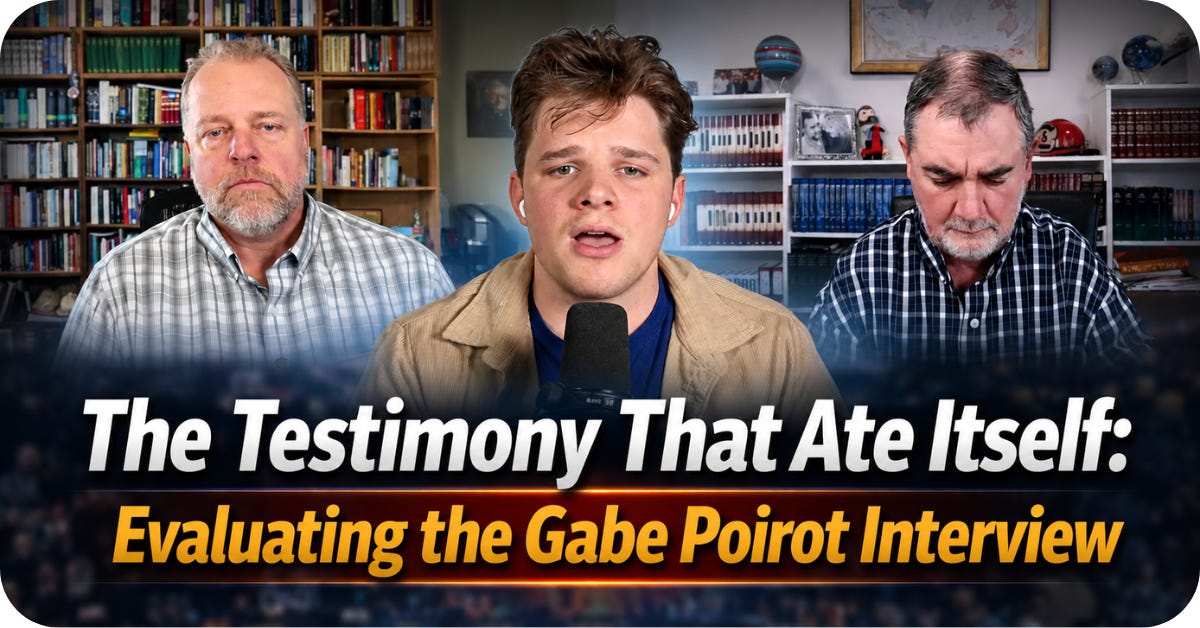
Maybe you’ve been following the story of Gabe Poirot. He’s a young man who claims to have spent 18 days in heaven while in a coma after a skateboarding accident, and he’s written a book about it. He’s made the media rounds promoting that book, Fox News, Sid Roth, Joseph Z, and others, and the claims he made in those appearances are, to put it charitably, wildly unbelievable. But the thing that’s stood out to me most isn’t the claims themselves. It’s that nobody ever pushed back. His descriptions of his experience were never lined up with Scripture in any of the interviews. The things he said about Jesus were never held up to what the Bible actually says. Every single one of his claims went unchallenged.
That all changed last week when Pastor Jim Osman and Justin Peters released a video on Justin’s YouTube channel where they walked through Poirot’s claims in detail and held them up against the only thing they should ever be compared to.. the Word of God. And what became clear is that Poirot’s testimony doesn’t hold up to a faithful reading of Scripture.
That video got back to Gabe himself, and, to his credit, he reached out to Justin and Jim to have a conversation. What came out of that was a two-and-a-half-hour Zoom call between the three of them that I just finished watching.
This is my evaluation of that conversation. Over the course of roughly 143 minutes, Poirot did something I don’t think he intended. He dismantled his own testimony while fully thinking he was defending it.
The most important thing is the pattern of methodical retreat that develops across the entire conversation.
Poirot proposes that he went to the third heaven, saw Jesus, received a message, and experienced nurseries, libraries, liquid love, prayers in golden bowls, and all the rest. By the end, he’s walked back or reframed virtually every specific claim he’s made publicly to millions of people. The nurseries, he shouldn’t have described them that way. The Sid Roth television program in heaven, that doesn’t represent his full heart. Jesus being unaware of why he was concerned, he misspoke and will clarify in future interviews. God saying, “you are even better than I thought you would be,” he publicly repents of that sentence.
The issue here is theological at the core. If Poirot actually went to heaven and actually saw these things, he can’t unsee them. You don’t walk back eyewitness testimony because someone on a Zoom call told you it sounded extra-biblical. If he saw nurseries, there are nurseries. If Jesus spoke to him and was genuinely unaware, then Jesus was genuinely unaware.
The fact that Poirot is willing to retract and apologize for these claims under pressure tells you something he may not realize he’s communicating. He knows, at some level, these aren’t reports of observed reality. They’re embellishments built on whatever experience he may have had during a coma, then interpreted and expanded through a charismatic theological framework.
A man who actually saw the glorified Christ doesn’t come on a Zoom call and say “I didn’t communicate my heart correctly there.” He says “I saw what I saw.”
Justin pressed this point when he said, “What part of your trip to heaven that you relate are we to take literally and believe?” That’s the right question, and Poirot never answered it because he can’t. The moment he admits that some of his claims are embellishments, the entire structure collapses.
Count how many times Poirot says “that doesn’t represent my full heart” or “let me express my heart” in this conversation. Every time Justin or Jim pin him down on a specific claim, Poirot pivots to his “heart.” That’s a deliberate strategy, whether he’s conscious of it or not. It moves the conversation from what’s objective (is this true or false?) to the subjective (what did I mean?), where nothing can be pinned down.
Jim and Justin both called the strategy out with Justin correctly saying, “I’m not interested in your heart. I’m interested in what you said, the claims that you’re making.”
That’s the issue. Scripture measures prophetic claims by the truth of what’s said, not the sincerity of the one saying it. Deuteronomy 18 asks “did the word come to pass?” and “did the LORD command him to speak it?” Poirot keeps going back to his heart as though that settles the issue. But that replaces the biblical standard for testing prophetic claims with an emotional one. Instead of asking, “Is this true, and does it line up with Scripture?” the question becomes, “Did he mean well, and does he seem sincere?” That’s a charismatic move, and it should be named for what it is.
In his initial response to Justin and Jim’s first video, Poirot referenced John in Revelation, Daniel, Ezekiel, and Isaiah as biblical precedent for his claims, but omitted Paul. In this interview, Poirot finally addresses 2 Corinthians 12, and argues that the Greek word for “inexpressible” (arrēta) means “beyond human capacity to describe” rather than “not permitted to speak,” and he tries to engage 1 Peter 1:8 (joy “unspeakable”) as a parallel.
From Logos,
The two passages employ distinctly different Greek terms to convey inexpressibility, reflecting their different theological concerns.
In 2 Corinthians 12:4, Paul uses ἄρρητα ῥήματα (arrēta rhēmata)—literally “inexpressible utterances”[1]. The full phrase reads: “he heard inexpressible things, which it is not lawful for a man to speak”[2]. This adjective carries the sense of something “unspeakably holy—too sacred to be uttered”[1]. The construction emphasizes a prohibition: not merely that the experience defies description, but that divine law forbids its articulation. The term ἄῤῥητος appears only here in biblical Greek[2], giving Paul’s mystical encounter a uniquely sacred quality.
By contrast, 1 Peter 1:8 employs ἀνεκλαλήτῳ (aneklalētō)—“inexpressible joy”[1]. This word denotes something “indescribable—defying expression or description”[1]. Rather than emphasizing prohibition, Peter’s term focuses on the inadequacy of language itself. The believer’s joy in Christ transcends verbal articulation not because it’s forbidden to speak, but because human words simply cannot capture its magnitude.
The theological distinction is significant: Paul’s inexpressibility stems from divine restriction protecting sacred mysteries, while Peter’s inexpressibility arises from the overwhelming abundance of spiritual experience. Both passages grapple with the limits of human language before the transcendent, yet they approach that limitation from opposite directions—one through divine law, the other through the sheer surplus of joy that believers experience in their unseen relationship with Christ.
[1] Rick Brannan, ed., in Lexham Research Lexicon of the Greek New Testament (Bellingham, WA: Lexham Press, 2020). [See here, here, here, here.]
[2] Hermann Cremer, in Biblico-Theological Lexicon of New Testament Greek, trans. William Urwick (Edinburgh: T. & T. Clark, 1895), 714.
But Poirot’s own argument turns against him, even if you accept his preferred reading. If arrēta means “beyond capacity to describe,” then that creates a bigger problem, not a smaller one.
Paul, who actually went to the third heaven says nothing about what he saw, (using Poirot’s preferred reading), because the experience was beyond his capacity to describe. Poirot, who claims a similar experience, seems to find it entirely describable.. in a book, on Fox News, and in interview after interview.
So his position creates a problem he can’t escape. Either Poirot’s experience was less profound than Paul’s, (in which case why should anyone treat it as remarkable?), or Poirot is describing things he didn’t actually experience, (which is exactly what Justin and Jim have argued.")
His own exegetical argument doesn’t help him here at all.
But even bigger than the word study are the things 2 Corinthians 12 says plainly that are never dealt with. Paul was forbidden to speak about the things he heard or saw, and he also refused to use that experience as some kind of credential. He says he would not boast on his own behalf except in his weaknesses, so that nobody would think more of him than what they see in his life and hear from his mouth.
And then God gave Paul a thorn in the flesh for the purpose of keeping him from exalting himself. Think about that. God saw the danger of pride from a real experience in heaven serious enough that He afflicted His own apostle to keep that from happening.
That puts this all in perspective. Paul was kept from turning his experience into a platform.
A significant part of the chat was spent on Poirot’s argument from Joel 2:28-32 / Acts 2:17-21 “your sons and daughters will prophesy, your young men will see visions, your old men will dream dreams.”
The standard charismatic proof-text for ongoing revelation and gifts, and Poirot leaned on it hard, repeatedly asking “where is the expiration date?”
Jim handled it well by pointing out that the text in Joel has eschatological pieces that haven’t been fulfilled. But the deeper hermeneutical problem is worth taking time to discuss.
Poirot’s argument assumes that because Peter cites Joel 2 at Pentecost, every element of that prophecy must remain fully active and ongoing throughout the entire church age until the end. Fulfillment of prophecy in Scripture doesn’t work that way. The “last days” Hebrews 1:2 talks about started with Christ’s first coming and stretches all the way to His return. Pentecost wasn’t the beginning of something that has to keep repeating the same way until the end of time. It was God doing something unique at a key moment in history.
The pouring out of the Spirit was real, and the gifts were real too. But those served a specific purpose. Paul says the church is built on the foundation of the apostles and prophets in Ephesians 2:20, and foundations don’t get laid over and over again. You lay one foundation.
So what we should be asking is what role these gifts played in God’s plan and whether that’s already been fulfilled.
Poirot never really deals with that. He reads Joel 2 like a flat promise that works the same way all through the church age, with no category for how God might have used those gifts at a specific time for a specific purpose.
But, even if you set all of that to the side, and even if you allow for the sake of argument that some form of prophecy continues today, his claims still fall apart. The issue is the content.
Even a continuationist is still required to test what’s being claimed. And when you do that here, it doesn’t hold up. The Jesus he describes lacks knowledge Scripture clearly assigns to Christ. His explanation of the Trinity drifts into modalistic language. The gospel he presents centers on giving God your yes instead of repentance and faith in the finished work of Christ.
That’s the real problem. This goes past a debate about whether revelation can still happen. It comes down to whether what’s being presented lines up with the Jesus of the Bible. It doesn’t.
Justin and Jim also pressed him hard on his claim that Jesus “didn’t know” and “was unaware” of why Gabe was concerned about his sin, and Poirot’s answer exposed just how confused his thinking really is.
Poirot tried to use Hebrews 8:12, “their sins and their lawless deeds I will remember no more” as justification. His point was basically that Jesus “not knowing” about his sin was like God “not remembering” forgiven sin. But that falls apart, and Jim was right to push on it.
Hebrews 8:12 is talking about a legal reality. God’s saying He no longer holds those sins against the believer. But make no mistake, God most certainly knows every sin every person has ever committed. He no longer counts those sins against those who are in Christ. That’s completely different from saying Jesus was unaware and didn’t know what Gabe was talking about, which is exactly how he described it in multiple places.
And then under pressure, he finally said, “Of course, he knew. He already knew. It was not that he was unknowing.” That confession damages his story because it directly contradicts what he said earlier on the Joseph Z program, where he said Jesus “was actually asking” and “he didn’t know what I was concerned about. He was never aware.”
So now, when he’s being pressed, Poirot’s saying something true about Christ. But when he does that he’s also confessing his earlier descriptions were false. He’s not clarifying, he’s correcting, and when you reach that point, the testimony itself starts coming apart.
If Jesus actually knew, as Poirot now says He did, then his earlier description of a Jesus who “was never aware” leaves him with a serious problem. Either he lied about what happened, or he badly misread his own experience. Either one wrecks the credibility of the testimony.
You can’t claim to have stood before the glorified Christ, looked Him in the eyes, and then report Him in a way that gets His nature wrong at such a basic level. And if the account can’t be trusted on something this central, whether Jesus knew what was in Gabe’s heart, then there’s no reason to trust it on anything else.
That’s the very point Justin made and Gabe never answered it. He couldn’t.
The Christological problem goes deeper than the omniscience issue here. The New Testament gives us a clear picture of the glorified Christ as He is right now. He searches minds and hearts (Revelation 2:23), nothing in creation is hidden from Him (Hebrews 4:13), He knows His people fully and intercedes for them continually as their great High Priest (Hebrews 4:15; 7:25), and even during His earthly ministry He knew what was in man and needed no one to tell Him (John 2:24–25). His knowledge was recognized by the disciples as evidence of who He is (John 16:30), in Him are hidden all the treasures of wisdom and knowledge (Colossians 2:3), and He now reigns in the place of highest exaltation (Philippians 2:9). That’s the Christ Scripture reveals, which means Poirot’s repeated claim that Jesus “didn’t know” and “was never aware” isn’t a small slip. It’s a direct contradiction of who Christ actually is.
My Observations
There are other things I could get into, like his refusal to call Kenneth Copeland a false teacher, but this blog is already getting long, and I want to make sure I point out a few things before I lose your attention.
The Joel 2 / Acts 2 exchange ate up too much of the conversation. Poirot kept dragging the discussion toward cessationism versus continuationism, and that’s the wrong framework for testing his specific claims. The real issue is what he’s claiming about Jesus. If what he’s describing doesn’t match the Christ revealed in Scripture, the argument is already over. And that’s true regardless of where someone lands on spiritual gifts.
The 2 Corinthians 12 argument has more depth that should be pressed in any future conversations. Paul didn’t just stay quiet because he was told to, he deliberately refused to build a platform on his experience. God gave Paul a thorn specifically to prevent self-worship. A real heaven experience brings a danger of pride, and God took action to keep that from happening. When you put that next to what Poirot is doing, the difference is clear.
The strongest single line in the entire interview came from Jim, “If you did that with every single claim that you’ve made, you wouldn’t have a book to sell.” The response was silence followed by a change of subject. Because Jim was right. Strip away everything that Poirot himself admitted was extra-biblical or poorly communicated, and what remains is the gospel that’s already in Scripture.. which needs no trip to heaven to proclaim.
Bottom line is this conversation confirmed everything Justin and Jim claimed in their first video, and it did so essentially through Gabe’s own words. His constant appeal to “my heart” rather than to the subject of his claims points in one direction.
This is a man who had some kind of experience during an 18-day coma, and has enhanced that experience using charismatic vocabulary absorbed from the Word of Faith world, and can’t defend those claims under even basic theological scrutiny.
Justin said he hopes Gabe will one day follow the path of Alex Malarkey and publicly retract his claims. I share that hope. The Gabe Poirot who showed up to this conversation, the one who kept saying “that doesn’t represent my full heart” is already most of the way there. He just doesn’t know it yet.
In His Service,

I talk about Jesus and the Bible a lot. Sometimes on the radio, sometimes to people who willingly show up to listen. Occasionally, I write things down.
Before You Go
Word of mouth predates every distribution platform ever built and still outperforms them. When someone sends you an article, you’re more likely to take it seriously because you trust the person who sent it. So, you’re not starting from scratch, you already have a reason to give it your attention.
Most of the people who read this got here that way. Passing something along like that is still the most helpful thing you can do.
Support the Writing (if you want)
Wretched Jim is free to read. If the writing has been helpful and you’d like to support the work, you can give here. No paid subscription necessary.
I haven't read this yet, but so excited to discover you are Substack, Jimmy! I've been listening to you and Todd on Wretched for years! I found your stack when I saw a tweet from Justin Peters about this very post of yours. Looking forward to reading it. God bless you and Happy Easter!
You hit the nail on the head. The best thing that happened here was they let Gabe bury himself by just talking. It exposed him. Very well written article sir.