


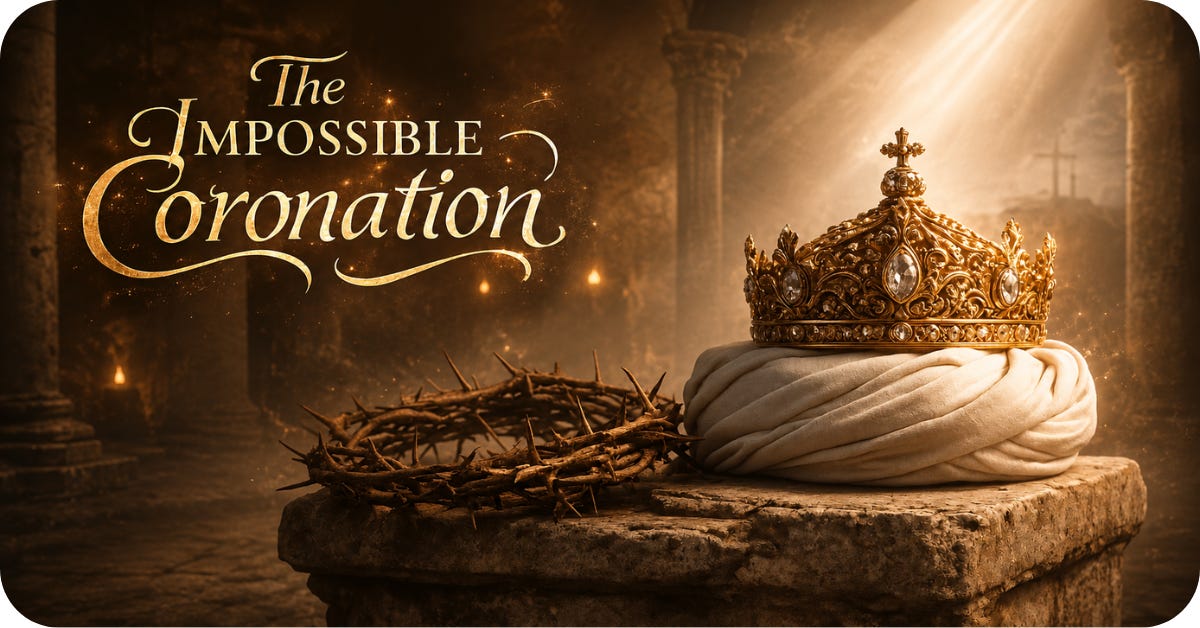
There’s a text in the Old Testament that almost nobody preaches at Christmas. And I get it.. when we think about Christmas sermons, we expect shepherds and angels. We expect Bethlehem and mangers. We expect something from Luke, or maybe Matthew..
But I want to take you somewhere unexpected today. Let’s look at Zechariah chapter 6.
I know. “Zechariah? At Christmas?” But, trust me.. when you see what God is doing here, it’s going to make Christmas bigger than you ever imagined.
What happens in this passage is one of the most shocking things in all of Scripture. It’s symbolic, yes.. but it’s really kind if mind-blowing when you understand how God has set everything up.
God commands His prophet to do something that under normal circumstances would be not just inappropriate, but actually illegal. The kind of act that could get you excommunicated. And the reason God commands this “illegal” act is because He’s about to show His people something they desperately needed to see.. something we also desperately need to see. He’s about to paint a picture of what Christmas would accomplish centuries before that night in Bethlehem.
Here’s the text:
“The word of the Lord also came to me, saying, ‘Take an offering from the exiles, from Heldai, Tobijah and Jedaiah; and you go the same day and enter the house of Josiah the son of Zephaniah, where they have arrived from Babylon. Take silver and gold, make an ornate crown and set it on the head of Joshua the son of Jehozadak, the high priest. Then say to him, “Thus says the Lord of hosts, ‘Behold, a man whose name is Branch, for He will branch out from where He is; and He will build the temple of the Lord. Yes, it is He who will build the temple of the Lord, and He who will bear the honor and sit and rule on His throne. Thus, He will be a priest on His throne, and the counsel of peace will be between the two offices.’”’ Now the crown will become a reminder in the temple of the Lord to Helem, Tobijah, Jedaiah and Hen the son of Zephaniah. Those who are far off will come and build the temple of the Lord.” Then you will know that the Lord of hosts has sent me to you. And it will take place if you completely obey the Lord your God. — Zechariah 6:9–15 (NASB 1995)
If you’re not familiar with the Old Testament structure, we can read that text and think, “Zechariah makes a crown. He puts it on the high priest’s head. What’s the big deal?”
But the big deal is that what God just commanded should not happen. It could not happen.. because the high priest has absolutely no business wearing a royal crown.
Crowns belonged to kings. And the promised royal line was going to come from the tribe of Judah. Priests, on the other hand, came from the tribe of Levi. And at this point in Israel, those two offices never met.
What we’re seeing is God orchestrating an impossible coronation to point to the only person in human history who could legitimately wear both crowns.
And that person was born in Bethlehem.
To understand why this is so shocking, we need to understand how God structured Israel.
When God brought Israel out of Egypt, He arranged them into twelve tribes descended from the twelve sons of Jacob. Each tribe had its role. But two of those tribes were set apart.
The tribe of Judah was the royal tribe. When Jacob blessed his sons in Genesis 49, listen to what he said over Judah:
“The scepter shall not depart from Judah, nor the ruler’s staff from between his feet.” — Genesis 49:10 (NASB 1995)
Quick detour here, because your brain might work like mine. We know King Saul wasn’t from the tribe of Judah, even though Genesis 49 says what it says. So this wasn’t a rule that a king couldn’t come from another tribe. It’s a promise that the scepter.. the permanent lineage.. would finally rest in Judah.
And then the tribe of Levi was the priestly tribe. When God established the tabernacle, He chose Aaron, a Levite, and his descendants to serve as priests forever. Numbers 3:10 couldn’t be clearer:
“So you shall appoint Aaron and his sons that they may keep their priesthood, but the layman who comes near shall be put to death.” — Numbers 3:10 (NASB 1995)
If anyone outside of the Levitical line tried to function as a priest, the penalty was death.
These two offices.. king and priest.. represented the two great needs of Israel.
The king represented God’s authority over His people. He ruled. He led. He protected. The king sat on a throne. He wielded a scepter.
The priest represented God’s access to His people. The priest was the mediator between a holy God and sinful humanity. He made atonement. He offered sacrifice. He entered the Holy of Holies.
Authority and access. And Israel needed both.
And God, in His wisdom, kept them separate. This wasn’t random. It was intentional. God was teaching Israel that no one man could fulfill both roles. No human could simultaneously have ultimate authority while also providing ultimate atonement. The jobs were too big.
We see this tension throughout Israel’s history. Every time someone tried to merge these offices, tragedy followed.
King Saul got impatient waiting for Samuel, who was the priest, to show up and offer sacrifices. So Saul took matters into his own hands. He offered the sacrifice himself. And Samuel’s response,
“You have acted foolishly; you have not kept the commandment of the Lord your God… for now the Lord would have established your kingdom over Israel forever. But now your kingdom shall not endure…” — 1 Samuel 13:13–14 (NASB 1995)
Saul attempted priestly functions, and it cost him the throne.
King Uzziah.. one of the greatest kings in Judah.. made the same mistake. 2 Chronicles 26 says that after decades of faithful service, Uzziah became proud. He went into the temple to burn incense on the altar, which was a priestly act. Eighty priests confronted him and said,
“It is not for you, Uzziah, to burn incense to the Lord, but for the priests, the sons of Aaron… Get out of the sanctuary, for you have been unfaithful.” — 2 Chronicles 26:18 (NASB 1995)
And when King Uzziah refused to leave, leprosy broke out on his forehead. He was a leper until the day he died.
One king who reached for the priesthood lost his kingdom. Another lost his health.
The two offices don’t mix.
And yet.. God commanded Zechariah to take a royal crown and place it on the head of Joshua, the high priest.
What in the world is happening?
Let’s keep digging into the context.
This is happening around 520 BC. The people of Judah have just returned from Babylonian exile. Everything is destroyed. The temple where the glory of God had dwelt.. destroyed. The whole nation is in ruins.
God raises up two prophets during this time.. Haggai and Zechariah. Their job was to encourage the people to rebuild the temple.
The leadership in Judah at this point consisted of two key figures. There was Zerubbabel, the governor.. a descendant of David, a man of royal lineage. He represented the kingly line, even though he wasn’t technically a king.
And then there was Joshua, the high priest.. a descendant of Aaron, legitimately serving in the priestly office.
Zerubbabel and Joshua. Working side by side, but still separate.
And in this setting, God speaks to Zechariah, telling him to take the silver and gold, brought by the returning exiles, make a crown, and put it on Joshua’s head.
Not Zerubbabel’s head. Joshua’s head. The priest gets the crown.
Imagine being Zerubbabel. Watching that ceremony. You’re the legitimate heir of David. Your ancestors come from the line of David. If anyone should wear a crown, it should be you.
But God passes over you and puts the crown on a priest.
What is God doing? He’s staging an act that violates the standard categories because He’s been pointing to Someone who will transcend all the standard categories. He’s placing a royal crown on a priestly head because one day.. there will be a Man who has every right to wear both.
And God doesn’t just have Zechariah do this silently. He explains what it means.
“Then say to him, ‘Thus says the Lord of hosts, “Behold, a man whose name is Branch, for He will branch out from where He is; and He will build the temple of the Lord. Yes, it is He who will build the temple of the Lord, and He who will bear the honor and sit and rule on His throne. Thus, He will be a priest on His throne, and the counsel of peace will be between the two offices.”’ Zechariah 6:12-13 (NASB 1995)
That’s the promise. Someday there will be a Man.. the Branch.. who will do what no one in Israel could do. He will build God’s temple. He will sit on a throne. And He shall be a priest on His throne.
Royal and priestly. In one person.
Now, let’s look at that title.. the Branch.. because that wasn’t random either.
If you’re an Israelite, that title makes your heart race. It was one of the greatest Messianic titles of that day.
Isaiah 11:1 says,
“Then a shoot will spring from the stem of Jesse, and a branch from his roots will bear fruit.” — Isaiah 11:1 (NASB 1995)
Jesse was David’s father, and the “stem of Jesse” is referring to the house of David being reduced to nothing, which is precisely what happened in the exile. But from that a branch would grow.
Jeremiah 23:5,
“Behold, the days are coming,” declares the Lord, “When I will raise up for David a righteous Branch; and He will reign as king and act wisely and do justice and righteousness in the land.” — Jeremiah 23:5 (NASB 1995)
And Jeremiah 33:15,
“In those days and at that time I will cause a righteous Branch of David to spring forth; and He shall execute justice and righteousness on the earth.” — Jeremiah 33:15 (NASB 1995)
Every time Israel heard “the Branch,” they knew it meant the Messiah.
So when Zechariah puts a crown on Joshua’s head and then says, “Behold the man whose name is the Branch,” he’s not talking about Joshua himself. Joshua was a type.. a shadow. Zechariah is looking through Joshua to Someone greater.
And here’s what makes this mind-blowing..
The Branch.. this Messianic figure from David’s line, is described as sitting on a throne where a priest is present. But not just present. The text says, “there shall be a priest on his throne.” Not beside his throne. On his throne.
When you look at the original language and how the Hebrew is constructed, the Branch is royal. He sits, and He rules. But the Branch is also priestly. One person. Two offices.
That’s what Zechariah saw 500 years before Bethlehem. This is exactly what God was promising through this “illegal-at-the-time” coronation. He’s promising that someday this separation between king and priest would end. Someday there will be a Man who could wear both crowns.. not by violating God’s law, but by fulfilling a category that transcended the law.
But how is this possible?
If kings come from Judah and priests come from Levi, how can one person be both? These tribes didn’t overlap.
Scripture answers the question. And it goes all the way back to Genesis 14.
The book of Hebrews takes us there..
“For this Melchizedek, king of Salem, priest of the Most High God, who met Abraham as he was returning from the slaughter of the kings and blessed him, to whom also Abraham apportioned a tenth part of all the spoils, was first of all, by the translation of his name, king of righteousness, and then also king of Salem, which is king of peace. Without father, without mother, without genealogy, having neither beginning of days nor end of life, but made like the Son of God, he remains a priest perpetually.” — Hebrews 7:1–3 (NASB 1995)
Melchizedek was both king and priest. He was king of Salem, which would later become Jerusalem.. and priest of the Most High God.
This was centuries before the law was given. Centuries before Levi and Judah were ever born. Before God established the Levitical priesthood, Melchizedek was a priest-king who foreshadowed all of those categories.
Psalm 110 is a Messianic psalm that David wrote about his own greater Son..
“The Lord says to my Lord: ‘Sit at My right hand until I make Your enemies a footstool for Your feet.’” — Psalm 110:1 (NASB 1995)
But then in verse 4,
“The Lord has sworn and will not change His mind, ‘You are a priest forever according to the order of Melchizedek.’” — Psalm 110:4 (NASB 1995)
The Messiah will be a king who sits at God’s right hand. And the Messiah will be a priest forever.. not after the order of Aaron, not from the tribe of Levi, but after the order of Melchizedek. A priest-king.
This is what God has been planning all along.
The Levitical system was never meant to be permanent. It was a shadow. Hebrews 7:11,
“Now if perfection was through the Levitical priesthood (for on the basis of it the people received the Law), what further need was there for another priest to arise according to the order of Melchizedek, and not be designated according to the order of Aaron?” — Hebrews 7:11 (NASB 1995)
The Levitical system couldn’t perfect anyone. It couldn’t actually take away sin. Hebrews 10:4,
“For it is impossible for the blood of bulls and goats to take away sins.” — Hebrews 10:4 (NASB 1995)
The whole system was temporary. It was pointing to one Person.
Jesus of Nazareth.
So what does any of this have to do with Christmas?
Everything. Absolutely everything.
For the Branch to be both king and priest, something specific had to happen. He had to be born. The incarnation was necessary for the prophecy to be fulfilled.
To be the king, the Messiah had to be a descendant of David. That was non-negotiable. God’s covenant with David in 2 Samuel 7 promised that David’s offspring would reign forever. The Messiah had to be born of David’s line.
And Jesus was.
Matthew’s gospel proves that Jesus is the son of David, the son of Abraham. Luke’s genealogy traces Jesus back through David all the way to Adam. The angel Gabriel told Mary in Luke 1,
“He will be great and will be called the Son of the Most High; and the Lord God will give Him the throne of His father David; and He will reign over the house of Jacob forever, and His kingdom will have no end.” — Luke 1:32–33 (NASB 1995)
Jesus has every right to David’s throne. The crown belongs to Him.
But to be the priest, something else had to happen. The Messiah had to be able to offer a sacrifice. And Hebrews tells us plainly that you can’t offer a sacrifice for humans unless you are a human.
“Therefore, since the children share in flesh and blood, He Himself likewise also partook of the same, that through death He might render powerless him who had the power of death, that is, the devil, and might free those who through fear of death were subject to slavery all their lives. For assuredly He does not give help to angels, but He gives help to the descendant of Abraham. Therefore, He had to be made like His brethren in all things, so that He might become a merciful and faithful high priest in things pertaining to God, to make propitiation for the sins of the people.” — Hebrews 2:14–17 (NASB 1995)
The eternal Son of God couldn’t serve as our high priest while remaining God alone. For Jesus to be our priest, He had to take our nature. He had to be born. He had to have a body. He had to have blood. He had to be capable of suffering, capable of dying, capable of being the sacrifice that He Himself would offer.
Christmas is when Jesus acquired everything necessary to be our priest.
Think about it. When God the Son added human nature to His divine nature in Mary’s womb, He was preparing the sacrifice.. growing the body that would one day hang on a cross, forming the blood that would eventually be poured out for our sin.
Hebrews 10:5 tells us what Christ said when He came into the world,
“Therefore, when He comes into the world, He says, ‘Sacrifice and offering You have not desired, but a body You have prepared for Me.’” — Hebrews 10:5 (NASB 1995)
That’s what Christmas is. That’s what the manger holds. Not just a baby, but the Lamb of God being prepared for slaughter. The Branch had to branch out from His place. The eternal King had to descend into time. He had to be born in Bethlehem in order to be crowned on Calvary.
Now let’s look at the most beautiful phrase, for me, in the entire text.
Zechariah says,
“the counsel of peace shall be between the two offices.” — Zechariah 6:13 (NASB 1995)
Obviously, this means One is coming who will bring the two offices of king and priest together, in one.
But we can get even deeper here, if we’ll consider for a moment… the counsel of peace is when the kingly demand for justice and the priestly provision of mercy reached perfect agreement.
Think about our problem before God. We don’t have just one problem. We have two.
Our first problem is that we’re guilty. We’ve broken God’s law, and His justice demands payment. We’ve accrued a debt that we can’t pay, and justice can’t be ignored. God can’t pretend our sin doesn’t exist. He can’t compromise His holiness to look the other way at our rebellion.
That’s why we need a priest. We need someone to offer sacrifice and make atonement.
But we have a second problem. Not only are we guilty.. we’re rebellious. Sin isn’t just a legal problem. It’s a heart problem. We don’t just need our debt paid. We need to be crushed. Because left to ourselves, we’re gonna keep running from God forever. Our will is in slavery. Our heart is a heart of stone. We’re not gonna come to the light because we love the darkness.
That’s why we need a king. We need someone with authority who can break our chains.
And that’s the glory of Christ. Because He does both.
As priest, Jesus offered the perfect sacrifice.. Himself.. to satisfy God’s righteous justice and cleanse us from every sin. Our guilt is gone. Our debt has been paid. The Father’s wrath against our sin was absorbed by the Son in our place.
As King, Jesus defeated our rebellious, sinful hearts by His Spirit. He gave us a new nature. He brought us under His lordship.
And here’s the beauty. These two roles aren’t in tension anymore. They’re not competing against one another. In Christ, the counsel of peace is between them both.
The One who demands holiness is the same One who provides it.
In any other arrangement, you’d have a king demanding what you can’t give and a priest offering what a king might reject. But in Christ, the King accepts His own priestly provision. The Priest satisfies His own kingly demands.
The counsel of peace is between them both.
That’s why we can have assurance. The Judge is your Advocate. The King is your Priest. The One who has the authority to condemn is the One who died in our place. And He didn’t die for us and then hand our case to someone else. He Himself intercedes at the right hand of the Father right now for us.
If Jesus is our King.. our Priest-King.. then we have more than we ever realized.
We have a King who understands weakness. Most kings rule from a distance. They sit in palaces surrounded by luxury. How could a king understand the single mother working two jobs? How could a king understand the man battling drunkenness?
But our King was a priest first. Our King didn’t come in royal robes. He came in swaddling cloths. He didn’t come to a palace. He came to a feeding trough.
“For we do not have a high priest who cannot sympathize with our weaknesses, but One who has been tempted in all things as we are, yet without sin.” — Hebrews 4:15 (NASB 1995)
Our King has felt temptation.. and He resisted. Our King has felt rejection. He’s felt what it’s like to suffer.. and He understands. When we go to Him in prayer, we’re not approaching a distant ruler who has no idea what our lives are like. We’re approaching the One who became like us in every respect so He could represent us.
We have a priest who has all authority. Most priests are limited in what they can do. They can intercede, but they can’t mandate. They can approach and plead to a power higher than themselves and hope their petition is heard.
But our priest sits on a throne. Our priest has all authority in heaven and on earth. He doesn’t simply ask the Father to help us. He intercedes for us.
“And Jesus came up and spoke to them, saying, ‘All authority has been given to Me in heaven and on earth.’” — Matthew 28:18 (NASB 1995)
Our priest isn’t weak. Our priest rules.
We have an everlasting representative. Under the old system, priests died. They served for a while. They made sacrifices. They interceded for the people, and then they died. The ministry had to be passed on. That’s why it came from one line.
“The former priests, on the one hand, existed in greater numbers because they were prevented by death from continuing, but Jesus, on the other hand, because He continues forever, holds His priesthood permanently. Therefore He is able also to save forever those who draw near to God through Him, since He always lives to make intercession for them.” — Hebrews 7:23–25 (NASB 1995)
Jesus holds the priesthood permanently. He’s never going to be replaced. He never retires. He never dies. He always lives to make intercession. That means our representation before God is permanent. There’s never going to be a moment when we don’t have an Advocate. There will never be a moment when the throne room of heaven lacks someone speaking on our behalf.
We have access we don’t deserve. This is probably the most valuable reality. Under the old system, our access to God was limited. Only the high priest could enter the most holy place, and he could only do that once a year, and only with blood. The message was clear.. God is holy. We are not. And access is restricted.
“Therefore, brethren, since we have confidence to enter the holy place by the blood of Jesus, by a new and living way which He inaugurated for us through the veil, that is, His flesh, and since we have a great priest over the house of God, let us draw near with a sincere heart in full assurance of faith, having our hearts sprinkled clean from an evil conscience and our bodies washed with pure water.” — Hebrews 10:19–22 (NASB 1995)
Now we don’t have to wonder whether God will receive us. We don’t have to clean ourselves up before we pray. We have a Priest-King who has given us permanent, blood-bought access to the throne room of the entire universe.. not because we’re worthy, but because He is, and He represents us.
Let’s go back to verse 12:
“Then say to him, ‘Thus says the Lord of hosts, “Behold, a man whose name is Branch, for He will branch out from where He is; and He will build the temple of the Lord.”’” — Zechariah 6:12 (NASB 1995)
Behold the man.
Centuries after Zechariah wrote those words, another voice spoke them. It was Pontius Pilate.
After placing the crown of thorns on Jesus’ head, and putting a royal purple robe on Him to mock Him, Pilate brought Jesus before the crowd and said,
“Jesus then came out, wearing the crown of thorns and the purple robe. Pilate said to them, ‘Behold, the Man!’” — John 19:5 (NASB 1995)
Pilate meant it as mockery. He was saying, “Here’s your pathetic king. Your failed Messiah. The man you thought would save you.”
And he spoke more truth than he knew.
Behold the man. The man Zechariah foresaw. The man who would unite King and Priest in His own person.
Behold the man wearing a crown.. not of silver and gold, but of thorns.
Behold the man exercising His priesthood.. not with the blood of bulls and goats, but with His own blood.
Behold the man whose throne was a cross.. whose altar was a hill called Calvary.. whose royal proclamation was:
“Therefore when Jesus had received the sour wine, He said, ‘It is finished!’ And He bowed His head and gave up His spirit.” — John 19:30 (NASB 1995)
This is your King. This is your Priest. This is your Branch. This is Christmas.
Let this Christmas be different. Let this Christmas bring you face to face with the glory of the incarnation.. not just that God became a baby, but that God became a baby so He could become our Priest, so He could become our King, and so He could unite in His one person everything we need for salvation.
We don’t need two saviors. We don’t need a priest to forgive us and then find a separate king to rule over us.
We need only Jesus.
Jesus.. the baby in the manger.. grew up to wear a crown of thorns so that He could one day place the crown of life on your head. The infant who couldn’t lift His own head would one day bow that head in death for our sake.. and then lift it again at the resurrection, never to bow it in death again.
Because He has risen. He is reigning. He is interceding. And He will come again.
And when He does, every eye will see what Zechariah saw in the shadows. Every knee will bow to that Priest-King, and every tongue will confess that Jesus Christ is Lord.
But we don’t have to wait until then to acknowledge His lordship. We can come to Him this very moment.. not cleaning ourselves up first, not attempting to earn His favor, because we can’t.
We just come.
Come to the One who has all authority to receive us, and all priestly mercy to cleanse us.
Behold the man whose name is the Branch.
Behold our Christmas.
In His Service,

I talk about Jesus and the Bible a lot. Sometimes on the radio, sometimes to people who willingly show up to listen. Occasionally, I write things down.
Before You Go
Word of mouth predates every distribution platform ever built and still outperforms them. When someone sends you an article, you’re more likely to take it seriously because you trust the person who sent it. So, you’re not starting from scratch, you already have a reason to give it your attention.
Most of the people who read this got here that way. Passing something along like that is still the most helpful thing you can do.
Support the Writing (if you want)
Wretched Jim is free to read. If the writing has been helpful and you’d like to support the work, you can give here. No paid subscription necessary.