


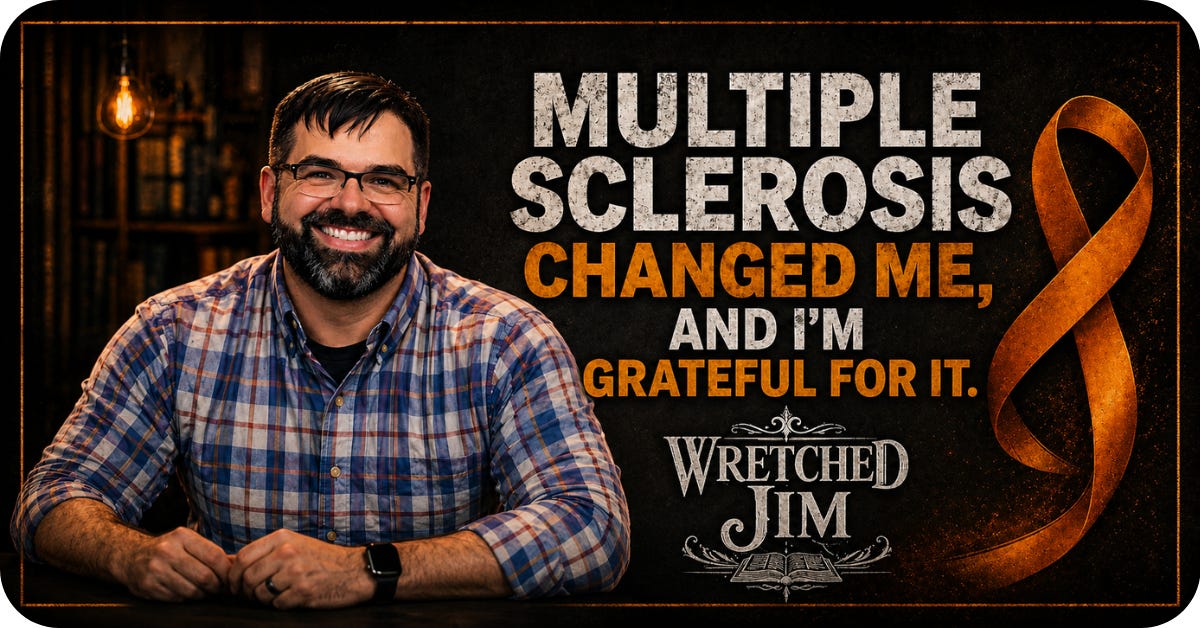
I’ve written this article over and over for a couple of years. I’ve worked on a draft here and there, but I’ve always ultimately decided against it. I don’t write about my health much at all, and it isn’t that I’m exactly private about it. It’s more that I’ve never desired to be the face of a disease. That sounds a bit counterproductive to my condition, I know. But there’s a trend that effectively takes a person’s malady and turns it into a platform, and I’ve seen enough of that to know I want no part of it.
I’ve also been cautious about writing from inside a situation, rather than from the far side of it. MS doesn’t really have a far side, at least not this side of heaven, but I think you understand the point.
Still, some things are worth saying once, especially when the purpose isn’t to draw attention to the suffering itself but to the God who has ruled over it. MS Awareness Week gave me a fitting occasion to write something I’ve wanted to say for a long time, and if I’m going to say it, I want to say it the way it actually happened. I don’t want this to read like one of those polished sickness testimonies where everything gets sanded down to a clean little inspirational lesson. That doesn’t help anybody. It certainly wouldn’t have helped me in the early months after my diagnosis.
I’m also aware that there are people reading this who are further along in a much harder version of the same struggle. People with progressive forms of MS that mine hasn’t become, or people with cancers that won’t respond to treatment. There are those out there who have buried children or lost spouses, and I don’t want to write a single thing that suggests I’ve suffered the way they have, or that my relatively mild six-year experience entitles me to lecture them about theirs. What I can offer is what the Lord has done in me through what He has chosen to send, and the hope is that something in that will serve people whose situation looks different than mine.
So let me begin where this has to begin, with a sentence I wouldn’t have predicted writing six years ago.
Multiple sclerosis changed me, and I’m grateful for it.
I want to be careful about how that comes across. When I say I’m grateful for MS, that doesn’t mean I’m grateful for the numbness I occasionally get down my entire right side. It doesn’t mean I’m grateful for the brain fog and fatigue I fight every day. I’m not grateful for what I’ve had to give up or the daily concessions the disease demands. None of that stuff is pleasant, and I won’t be disingenuous by pretending it is. But what God has done through this disease is a different matter entirely, and that I am grateful for without reservation.
To understand why, you really need to know who I was before October of 2020. The diagnosis itself won’t make sense unless you see the man it hit. I’ll ask you to walk with me through some of that before we get to the disease, because the disease isn’t the main part of this story. The main part of this story is the Lord, who was at work on me well before October of 2020, and who used MS as one more instrument in a much longer project of sanctification.
I grew up in the South, which, in the 1990s Bible Belt, means you grow up with a familiarity with Jesus almost the same way you have a familiarity with sweet tea. He’s around, and He’s so normalized that saying His name out loud doesn’t cost you anything. So I knew the stories and enough Christian language to convince myself, like so many others around me, that I was a Christian.
The truth is, I had no real spiritual foundation. There was some church exposure, but there was no real gospel influence in my life in any meaningful way. I had sparse exposure to church. I played church league basketball in middle school, which meant I had to show up on Wednesday nights if I wanted to be on the team. That was about the extent of it for me. Once that ended after a couple of years, my church involvement was over, too. Jesus may have been familiar to me, but He wasn’t precious to me.
There’s a specific kind of confusion that doesn’t think of itself as confusion at all. It says the right words at the right time without ever having been broken by what the words mean. That was my condition, and I didn’t know it. I would’ve told you I was saved, and I would’ve argued the point if you’d challenged it. And I would’ve been dead wrong the entire time.
By high school, my attention narrowed to the usual things, football and chasing girls. I wasn’t hostile toward Christianity, I was just indifferent to it. Whatever my mouth might have said about faith on the rare occasions it came up, my life told a different story.
I met the woman who would become my wife in the summer of 1999, just as I was about to start my senior year of high school. I was driving around with a friend, and stopped at a gas station, where we both spotted her. My buddy did what teenage boys apparently feel obligated to do in those moments. He dared me to go talk to her. So I did, and I got her phone number. That was 1999, and we’ve been together ever since.
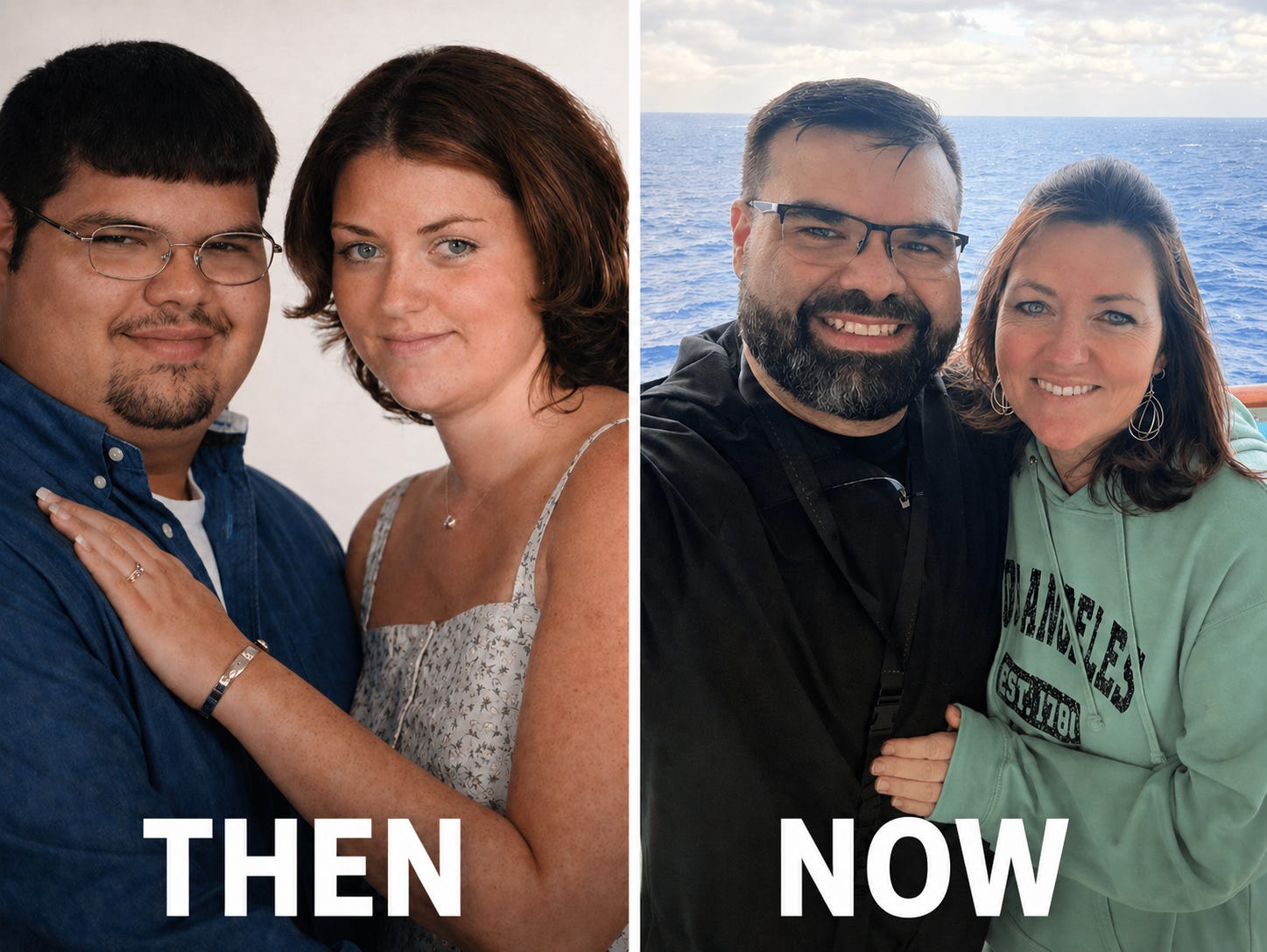
She grew up very differently from me. She was in church every time the doors were open, and her family was deeply involved in the Church of Christ. Melissa was never baptized in the Church of Christ, so according to their theology, she wasn’t saved. And that would be a partially accurate summation, because she wasn’t saved. Though her lack of salvation had nothing to do with her not being dunked, and everything to do with her never hearing the gospel. Her years of church involvement amounted to a lot of religious activity, and much of it produced resentment in her rather than love for Christ. She saw people who acted one way on Sunday and another way the rest of the week, and that kind of hypocrisy has a way of making a dead religion smell even worse to someone who already hates it.
She didn’t hate church because she was rebellious. She hated church because she recognized, probably rather profoundly, what was all around her. That recognition turned her off to all of it, and by the time we got married in 2003, she had no interest in going back.
So when we got married, we brought two very different backgrounds into the same house, and neither one of them included saving faith in Christ. I had a cultural familiarity with Christianity. She had church experience without the gospel. We were both lost, though we’d taken different roads to get there.
Life has a way of exposing that stuff.
When there’s no foundation underneath a marriage, the pressure doesn’t have to be too tense to reveal the cracks. It just has to be consistent, and what it revealed in me was a deep selfishness that I didn’t have the spiritual eyes to see at the time. I wasn’t leading Melissa the way a husband is commanded to lead and love his wife. What I was good at was chasing whatever made me happy and treating her concerns as interruptions to a life I thought I deserved.
Here’s a perfect example of exactly how ignorant and unaware I was. Around 2010, I bought a brand new truck. This was the first brand-new vehicle I ever owned, and I spent $30,000 without first talking to Melissa about it. I didn’t ask for her opinion or whether we could even afford it. And the delusional part, I drove home excited to show it to her, expecting her to be thrilled. When she wasn’t, in my mind, she was once again standing in the way of my happiness.
That’s how twisted sin makes a man. It takes selfishness and makes it feel like an affliction. It can take a husband’s refusal to lead and turn it into a husband’s right to be happy. I couldn’t see any of that at the time. I thought I was being a reasonable man, that was being treated unfairly by an unreasonable wife. Every conversation where she tried to raise a concern ended up filtered through the same worldview. She was standing in the way of me trying to be happy.
I tell that story now because I want to be honest about what the Lord saved me from, and I want to be honest about what the Lord had already been teaching Melissa to endure. By 2010, she had been carrying the weight of a marriage to an unsaved husband for seven years. Whatever God would eventually do in our home, He was already doing something in her long before He did anything in me.
Not long after the truck fiasco, a close friend of mine went through some serious struggles in his own life. Through those issues, I watched him reach out to his pastor, and I watched that pastor walk with him and help him. That was intriguing to me because I had no category for that kind of thing.
Eventually, my friend started seeing some light in his situation, and at that point, he started inviting me to church. Every week he would ask, and every week I had a new excuse. I had no intention of going, and so for weeks, I would politely decline. But he was persistent, and after ten or eleven weeks of not taking the hint, I finally told Melissa we probably should go just for the sake of being decent friends. So, we went.
I can honestly say I didn’t expect what I received. I expected the kind of church welcome lost people imagine when they have their defenses up. I thought people would stare. I thought I’d spend the whole service feeling judged, and that judgment would give me a reason not to go back.
None of that happened.
What I walked into was handshakes and hugs and a room full of people who were honestly glad to see me. Remember, this was small-town Southern America, so I already knew most of the people there. And you know what? That reaction disarmed me. I’d gone planning to be a good friend and then be done with it, but the truth is, the love and the warmth of those people made me go back.
It was after the second Sunday that the pastor told my friend he wanted the three of us to get together for lunch. I didn’t think too much about it. I just assumed he wanted to get to know me a little better, and that was the truth. But God had other plans, because at the table that day I heard the Gospel for the first time.
Don’t get me wrong, I’d heard the words before. I lived in the Bible Belt, remember? Of course, I’d heard the Gospel and knew the story. But that day, God gave me ears to hear the Gospel for the first time in my life. My sin was exposed to me in a way it had never been exposed before, and the Christ I had treated as familiar and insignificant suddenly became essential. No, I didn’t walk an aisle during a church invitation or pray some polished prayer. But I walked out of that restaurant a different man.
I remember telling my wife later that day, I thought I’d gotten saved. Her reaction was, “Saved from what?” My response was more profound than I even understood in the moment, but it’s what I honestly felt as I said, “I think I got saved from myself.”
I wasn’t fully aware of things then, but I was a dead man walking. I was dead in sin, and at that Applebee’s table on August 27, 2013, God breathed new life into me spiritually. It wasn’t a rededication or some kind of religious epiphany. No, I walked into that restaurant as dry bones, and God raised me to life.
About six months later, He saved Melissa, too.
I’d love to tell you everything immediately became easy, but that’d be a lie. The gospel didn’t sprinkle a little religion on an already healthy marriage. What it did was resurrect two spiritually dead people living under the same roof, and then the Lord began teaching us how to live as new creations. That kind of work is beautiful, but it’s not always neat and tidy. There were things in our marriage that had to be reckoned with. There were years of sinful patterns that didn’t dissolve the moment we were both converted. What regeneration gave us was the capacity to do the work. The work itself still had to be done, and in some ways, we’re still doing it, and I suspect we will be until the Lord calls one of us home.
Now, this is where we skip a whole lot and fast-forward over quite a bit. Remember, this isn’t an article about my life, but rather about MS and the impact it’s had on my life.
But first, I do need to say one thing about radio. Because the story doesn’t make sense, especially as I attempt to explain what the disease has taken from me, if I don’t first explain what radio had given me.
I never grew up dreaming of being on the radio. It wasn’t some childhood ambition for me. It was something I just fell into and fell in love with. I started out as a part-time weekend board-op for sports or remotes. Over 18 months, I worked my way into a full-time role, and as I said, it got into my blood. I fell in love with every aspect of this business. I loved the timing and the pressure of it. That stuff fascinated me. To hit a post cleaner than the time before was a thrill for me. There’s a flow to live radio that you either have or you don’t, and once you have it, the microphone feels like an extension of you, rather than a tool you’re using.
For twenty years, that was my world. Same station that I never thought I’d leave. I honestly believed, at some point, I’d buy the place. That was the trajectory I was on. I’d turned down larger opportunities over the years because nothing appealed to me the way my hometown did. Some men are built for ladder climbing. I wasn’t. I was built for the place I was born in, and I figured I’d spend the rest of my career there.
Then the Lord opened a door I never expected.
My path to Wretched I couldn’t have orchestrated if I tried. When God has His hands on something, He uses people and circumstances that seem insurmountable to us, but are nothing to Him. Nothing will ever alter the providential will of God. You are where you are right this moment because God deemed you to be there, and He used people and circumstances to lead you there. As He did with me.
Without going into too many details, I met Todd Friel in February 2020. By August 2020, my family and I were living in Atlanta, GA, and I was the producer of the nationally syndicated Wretched Radio.
The Lord had been arranging this for longer than I’d realized, but that wasn’t all He was arranging.
Three months later, the first symptoms came.
It was a Sunday when I woke up and noticed the right side of my body was numb. My arm, leg, and part of my face didn’t feel right. I was off balance as I walked, and my thinking felt slowed. At first, I thought it would pass. I hadn’t been sleeping well, and just blamed it on that, because that’s what you do when something strange happens, you don’t want to acknowledge. You find reasons not to mention it to anyone.
The next day at work, Todd noticed something was off and asked me what was going on. I told him my whole right side felt weird, and I was falling over when I walked. Told him about the slowed thinking and hard time focusing, which is what he noticed as we were doing radio. He told me I needed to see a doctor, but I’m stubborn and said I wanted to wait a couple of days. This is where you and your wife working in the same place can be a benefit and a detriment, but only a detriment if you want to continue being stubborn, I guess. Todd went straight from me to Melissa and told her to take me to a doctor right then. Not tomorrow. Right then.
But, to speed this up again, and not get into unnecessary details, I went to the ER that day, where I was given a diagnosis of possible MS. Possible because there’s only so much they’ll say in the ER. A lot of testing by a neurologist has to be done, and a lot of things need to be ruled out before they finally give an MS diagnosis. The official diagnosis did, indeed, come in January 2021.
So, quickly, if you don’t know much about multiple sclerosis, it attacks the central nervous system. It damages the protective covering around the nerves in the brain and spinal cord, which affects how signals travel between the brain and the body. That’s the simple explanation. The fleshed-out, real-life version is harder to put into words because the disease doesn’t affect every person the same way. Different people have different symptoms. Some people have more numbness, and some have more cognitive difficulties than others. For me, fatigue and cognitive function have been my biggest challenges.
I could handle numbness better than I could handle losing my cognitive reaction. That may sound strange, but if you’ve lived your professional life by being reactively quick, you understand why it mattered to me. Live radio is a different kind of beast. It’s not as life-or-death as some jobs where thinking on your feet is critical. It’s not law enforcement, or being a doctor, nurse, or fireman, or a 911 operator, or a pilot, or any number of other professions. But there is a specific kind of mental processing that has to happen immediately. As a person hears something, they simultaneously process it, decide whether and how to respond, before the moment disappears. I loved that about radio. I had spent years doing it at a high level.
After MS, I couldn’t do it the same way anymore.
I’d sit with Todd and feel the delay. He’d say something, and by the time my mind found the thing I might have added, we’re 60 seconds past the moment, the conversation’s moved on. It wasn’t that I had nothing to add. It was that my brain didn’t pull it up in time. For a man whose life had been lived on a live microphone, that was a kind of death.
That’s the part people may not understand. The grief wasn’t only medical. I was grieving the loss of a version of myself I trusted entirely too much.
There was a period in that first year after the diagnosis where I felt like I was watching another man do my job. I knew what to do, could still even do most of it. But the part that made me who I was on the radio, it was gone, and you have to try to put yourself in my shoes to fully grasp it.
I spent 20 years developing skills in small-market USA, skills I knew would translate to larger areas. Now, here I am. The opportunity has come, I’m on national radio, on 1,000+ radio stations daily, doing unscripted radio about my favorite thing in the world - theology. I should thrive. And then, BOOM. My ability to communicate and operate in that setting was taken away.
Radio people know what I’m describing. If you haven’t done live daily radio, the closest comparison would be losing a step as an athlete. The body and mind are still in operation, but not at the level they were. In live radio, just like on a football field, there’s no way to hide a lost step. The microphone doesn’t lie. The audience doesn’t know you’re doing everything you can to compensate. They just hear what you said, or what you didn’t say.
Now, I do want to pause here, because if this article stops at just an MS diagnosis and loss of cognitive ability, it’s really just a testimony to my professional life.
But what nearly six years of living with this has exposed is that God was doing something long before the disease arrived.
Before MS, I built so much of my identity around being quick-witted and having impeccable timing. I liked being able to respond in the moment and being the guy who always had the right thing to say. Some of that was personality, and some of it was training. But far too much of it was pride.
Back home, before I came to Wretched, I had a podcast with some friends. On that podcast, I was sharp-tongued. I didn’t mind calling out false teachers or saying the hard thing that made people uncomfortable. Now, there certainly is a biblical place for that. False teaching must be confronted, and the church has become too allergic to the kind of warning these days.
But my problem wasn’t that I believed errors should be confronted. My problem was that I liked being the one doing it.
I didn’t always ask whether a situation needed my opinion, or whether what I was about to say would serve the people listening. I didn’t consider my tone and whether it matched the seriousness of the topic. I had the ability to speak and think quickly and with clarity, and I treated that ability like it was the same thing as wisdom.
It wasn’t.
Then MS took that away from me, and God used that loss to teach me restraint. He made me sit in silence, for months, and watch Todd.
What I learned from Todd, through his example, was that the ability to say something doesn’t mean the specific moment requires it, and that a man can be technically right while still being spiritually careless.
Proverbs says,
“When there are many words, transgression is unavoidable, But he who restrains his lips is wise.”
(Proverbs 10:19)
James says,
“This you know, my beloved brethren. But everyone must be quick to hear, slow to speak and slow to anger”
(James 1:19)
I used to read that as a command and as an instruction. Now I read it with gratitude for the affliction that’s forced me to obey in ways I avoided before.
I sat with Todd on the radio for months, trying to catch up to a conversation, and through it, the Lord taught me grace and humility and the discernment I lacked before. He taught me not everything needs my opinion, and that even when something does need a response, the question isn’t whether I can be clever. The question is whether what I’m about to add is actually helpful to the person hearing it.
Todd was patient with me, and still is, in ways I’ll never be able to repay. He could’ve been frustrated or decided this wasn’t working out. He could’ve justifiably concluded that I wasn’t the man he hired. He’d hired someone with abilities he no longer possessed. Instead, he graciously gave me room to find my way back, and the Lord used his patience as one of the instruments of my sanctification. If I’d been working for anyone else during that period, I’m not sure I would’ve made it through the adjustment.
All that to simply say, if it took a disease to make me close my mouth long enough to listen, I’ll gladly take it.
Again, I thank God for MS, but I don’t thank Him because MS is pleasant. I thank Him because He’s used it to make me more dependent on Christ. I thank Him because He’s done spiritual work through it that I’m convinced wouldn’t have happened any other way.
That doesn’t make the disease good. It means God is good enough to use it. Those are two different claims, and faithful Christians need to be able to hold them both at the same time. If you conflate them, you get the prosperity gospel. If you separate them entirely, you get a God who only works around the edges of a world He can’t really control. The biblical picture is that a good God uses painful things for holy ends, and that the goodness of the ends doesn’t sterilize the hardness of the means.
MS took my quick thinking and wit and slowed me down. At first, I only felt the loss, but over time, I began to see the gift inside the limitation. The writing I do now requires a slower man than the one I used to be. Before MS, I could talk quickly, but I didn’t sit with things long enough. The Lord slowed me down, and the slower pace has become fruitful.
I say that carefully, because MS is frustrating. Don’t hear that it isn’t. There are days when my mind feels like it’s moving through mud. There are conversations where I know what I want to say, but the words don’t come when I need them.
Even so, I can look at the Lord and see His kindness.
I also don’t want to waste this. MS took things I once built my identity on, but God gave me something better through the loss. He built a deeper dependence on His word than I had before. His sovereignty has become more than a doctrine I can defend.
I wouldn’t have chosen this for myself, but I can look back now and say the Lord has been kind, and I can look ahead to whatever comes next and say with Job,
“Though He slay me, I will hope in Him.”
(Job 13:15)
That’s what MS has done in me.
The hard hand of God is still the hand of a Father. He knows how to bend His children without breaking them, and He knows what to take, and what to give back in its place.
This isn’t the life I planned. It’s the life He gave me.
And in the end, that is enough.
In His Service,

I talk about Jesus and the Bible a lot. Sometimes on the radio, sometimes to people who willingly show up to listen. Occasionally, I write things down.
Before You Go
Word of mouth predates every distribution platform ever built and still outperforms them. When someone sends you an article, you’re more likely to take it seriously because you trust the person who sent it. So, you’re not starting from scratch.. you already have a reason to give it your attention.
Most of the people who read this got here that way. Passing something along like that is still the most helpful thing you can do.
This was such a powerful and honest testimony. I really appreciated how you held both realities at the same time, the real loss and frustration, and also the deep, refining work God has done through it. That kind of honesty makes this so much more meaningful than a polished version ever could.
Because I was born with cerebral palsy, my experience with disability has always been part of my normal. I haven’t had to grieve the loss of abilities in the same way someone with an acquired disability might. But through my work with college students who acquired physical disabilities later in life, I’ve seen how heavy that kind of loss can be. There’s a unique frustration in remembering what your body used to do and having to adjust to what it can do now. At the same time, I’ve also been deeply encouraged by their resilience. Watching them move through that frustration with determination has been both humbling and inspiring.
Your reflection on how God used this to teach you restraint and humility really stood out. It’s such a different way of looking at suffering, not just as something to endure, but as something God actively uses to form us in ways we wouldn’t choose on our own. Thank you for sharing this with so much depth and truth. It points so clearly to God’s goodness without minimizing the cost.