


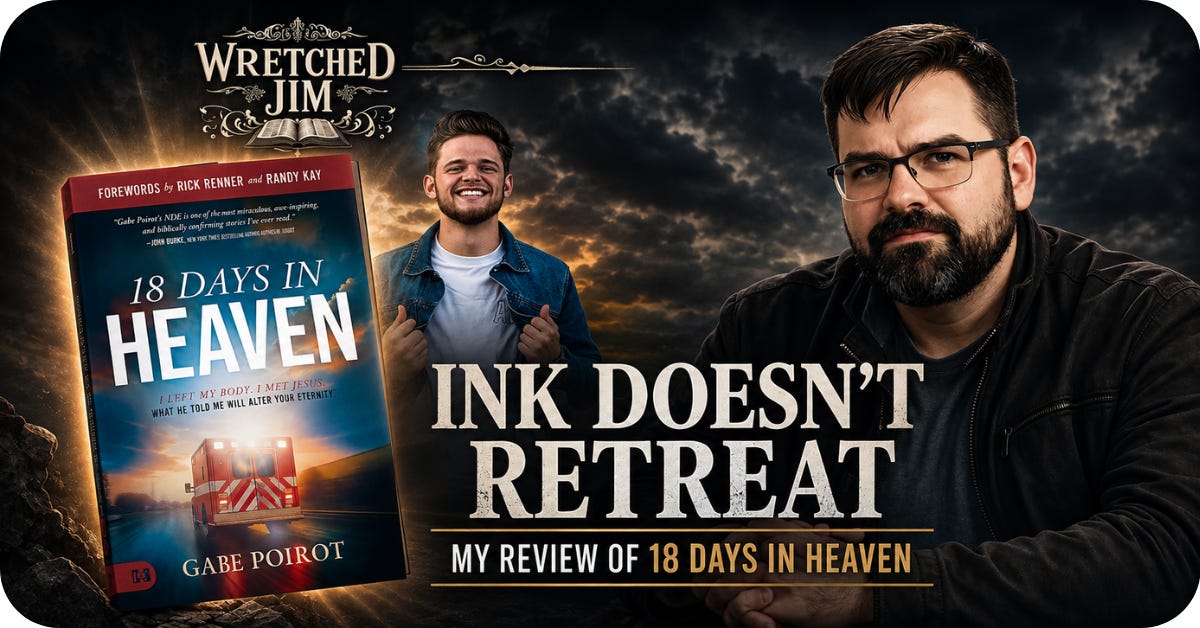
Gabe Poirot’s book, 18 Days in Heaven, is out, and it’s everything his interviews promised it would be, emotionally compelling and theologically disastrous.
I wrote a piece a couple of weeks back evaluating the two-and-a-half-hour Zoom conversation between Poirot, Justin Peters, and Jim Osman. In that conversation, Poirot systematically walked back claim after claim under basic theological pressure. He retracted a direct quote he’d attributed to God. He conceded that Jesus is omniscient after having said publicly that Jesus “was never aware” of what he was thinking. He backed off his descriptions of nurseries and libraries in heaven, telling Justin and Jim that those explanations didn’t represent his “full heart.”
His book changes the landscape of that conversation because the claims Poirot was willing to soften verbally are now in print, permanently, with his name attached. He can’t walk them back anymore. And the book is far worse than anything he said on camera.
I’ve read the entire thing, and what follows is my evaluation.
The first thing I want to point out comes from the bonus chapter at the end of the book. In that chapter, Poirot writes,
“My intention is to never go beyond the written Word of God. In fact, what is written is the very foundation of whom I encountered and everything I saw. I have not offered my ‘opinion’ on this matter. Instead, I have simply given you His Word.”
— Gabe Poirot, 18 Days in Heaven, p. 150
I want that statement to serve as the foundation for this entire review. Because if that’s the standard Poirot set for himself, his own book fails on virtually every page.
The book describes libraries in heaven filled with eternal wisdom, universities where revelation never ceases, monuments that tell God’s story, mansions handcrafted by Jesus as a carpenter, a sapphire floor in the throne room, flowers and trees that sing in harmony, colors that can be heard and tasted, prayers that build literal bridges between earth and heaven, fallen angels that continue to interbreed with humanity after the flood, “Gabriel” written on the scars of Christ’s wrists, Father God speaking specific sentences about Gabe before creation, and Jesus speaking prophetic words over Gabe at various ages throughout his childhood.
None of that’s in the written Word of God. Every one of those claims goes beyond Scripture. Poirot says he hasn’t offered his opinion and has “simply given you His Word” in a book where he describes Jesus as roughly 5’11” with purple eyes. The disconnect here is so extraordinary that it’s hard to know whether Poirot is being dishonest or whether he genuinely doesn’t understand what “go beyond the written Word” means. Either way, the disclaimer crumbles under the weight of the book it’s written in.
The contradictions in the book are significant and follow a pattern. Poirot consistently makes two claims that can’t coexist, apparently without noticing the tension between them.
In Chapter 5, he writes the Father “knew everything about me” and “saw me as if I were Jesus Himself.” One chapter later, in Chapter 6, he writes, “He sincerely had no memory of my sin. There was no record of my mistakes in heaven.” The Father who “knew everything” about Gabe just one chapter earlier now had no memory of his sin. To know everything about someone and yet remember none of their sin is impossible. Those claims are mutually exclusive.
In Chapter 16, Poirot describes the throne room, “There was nothing I could hide. There was nothing I could fake or put on a show about. The very oxygen of heaven only exists in 100 percent truth.” In Chapter 6, he says, “In His very presence, my sin did not exist because it wasn’t who I was.” If heaven operates in 100 percent truth and nothing can be hidden there, then Gabe’s sin history is part of that truth. It’s a historical fact. Saying it “did not exist” in a realm where only truth exists is a contradiction Poirot never attempts to resolve.
Chapter 1 closes with the thesis statement, “Heaven is not just a location. Heaven is Him.” The rest of the book proceeds to describe heaven as the most elaborately detailed location in the history of the heavenly tourism genre.. mansions, libraries, universities, golden streets, pearly gates, sapphire floors, mountains, beaches, cities, a river of life, an ocean, canyons, flowers, butterflies. He spends chapters cataloging the geography of a place he says isn’t really a place.
In Chapter 9, Poirot writes, “The entire time I saw how Jesus was only focused on me, throughout all of eternity. He could never take His eyes off me.” Throughout the rest of the book, Jesus functions as a tour guide.. “He then took me to a place where He showed me a film” (Ch. 9), “Jesus took me on another timeline” (Ch. 14), “I was then taken back to the time Jesus spoke” (Ch. 16), “Jesus then took me to another place on the circular timeline” (Ch. 27). Jesus can’t be simultaneously locked in exclusive eye contact with Gabe and conducting multi-chapter guided tours of heaven’s resources. The intimate-gaze narrative and the tour narrative require a different Jesus, and both are functioning in the same book.
The Christological problems go deeper than the book simply contradicting itself. The claim in Chapter 6 that Jesus “sincerely had no memory” doesn’t just conflict with what Poirot wrote in Chapter 5. It also conflicts with what Poirot himself conceded in the Zoom interview with Jim and Justin, when he said, “Of course, he knew. He already knew. It was not that he was unknowing.” Poirot told them to read the book, and they’d understand his heart. Fair enough. But readers are also entitled to understand his words. The book says Jesus “sincerely had no memory.” Either that concession wasn’t true, or the book isn’t. Both can’t be true.
But the damage in Chapter 6 goes further than that single line. Poirot puts a direct quote in Jesus’ mouth, “My brother, why are you looking for that which does not exist?”“My brother, why are you looking for that which does not exist?” The judicial language in Hebrews 8:12, where God chooses to no longer hold forgiven sins against the believer, is a legal declaration. Poirot’s version is something else entirely. This is Jesus presented as genuinely confused about why Gabe is looking for something. The phrasing “that which does not exist” means Jesus is saying Gabe’s sin literally has no existence in any form. That contradicts every text in the New Testament that describes Christ’s ongoing knowledge of His people.
And I will kill her children with pestilence, and all the churches will know that I am He who searches the minds and hearts; and I will give to each one of you according to your deeds. (Revelation 2:23)
And there is no creature hidden from His sight, but all things are open and laid bare to the eyes of Him with whom we have to do. (Hebrews 4:13)
For we do not have a high priest who cannot sympathize with our weaknesses, but One who has been tempted in all things as we are, yet without sin.(Hebrews 4:15)
But Jesus, on His part, was not entrusting Himself to them, for He knew all men, and because He did not need anyone to testify concerning man, for He Himself knew what was in man. (John 2:24-25)
That’s the Jesus of Scripture. Poirot’s Jesus can’t do what the biblical Christ does by nature.
Chapter 6 also describes “Gabriel” written on the scars of Christ’s wrists. That sentimentalizes the atonement and strips it of its true character. Christ didn’t die for Gabe to the exclusion of everyone else. He died for His people. The scars point to what Christ suffered in order to redeem His people. Putting one man’s name on the Savior’s wounds turns the atonement into a private souvenir.
The open theism in this book is more deeply embedded than the one quote Poirot later tried to retract in the interview.
In the Zoom conversation, Poirot publicly repented of attributing to God the words, “you are even better than I thought you would be.” Justin rightly identified the open theism in that statement. It presents God as surprised, one who learns new information that he didn’t previously know. Poirot retracted it.
But the book is built on the same theological framework. Chapter 25 says it outright, “God is not in control or causing everything that occurs on the earth. He is a gentleman.” The same chapter goes on to argue that Jesus “couldn’t” do miracles in Nazareth because human free will limited His ability. So this is bigger than one bad sentence that got retracted in an interview. It’s a theological system. Chapter 7 makes that even clearer, putting these words in the Father’s mouth before creation, “This one is the one I have always wanted. He is going to be just like me. Finally, one I can fellowship with and talk with.” That word “finally” implies God lacked fellowship before creating Gabe, which denies the eternal, perfect fellowship of the Father, Son, and Spirit. The Trinity didn’t need Gabe. God has never lacked anything.
nor is He served by human hands, as though He needed anything, since He Himself gives to all people life and breath and all things; (Acts 17:25)
Then, in the same chapter where Poirot says God isn’t in control, he quotes Romans 8:28,
“God causes all things to work together for the good of those who love God.” (Romans 8:28)
He even adds, “Notice the contingency there.” But the text says “all things,” and Poirot just said God isn’t causing everything. The verse and his theology can’t coexist, and they appear in the same chapter.
The book's soteriology confirms this. The salvation prayer at the end, “Jesus, yes. I say yes. I am done living life on my own. I want to know You today. I say yes to what You say.” There’s no mention of sin as offense against a holy God, no substitutionary atonement, no repentance, and no faith in the finished work of Christ. This is the same “give Him your yes” non-gospel that Justin and Jim identified in the interview, now permanently published as the book’s closing invitation.
The 2 Corinthians 12 problem is now worse than it was during the interview, because Poirot addresses the passage directly in his bonus chapter.
He quotes 2 Corinthians 12:2-4 as biblical precedent for his book, “I was caught up to the third heaven fourteen years ago... But I do know that I was caught up to paradise and heard things so astounding that they cannot be expressed in words, things no human is allowed to tell.”
The verse actually reads, in reliable and literal translations,
I know a man in Christ who fourteen years ago—whether in the body I do not know, or out of the body I do not know, God knows—such a man was caught up to the third heaven. And I know how such a man—whether in the body or apart from the body I do not know, God knows— was caught up into Paradise and heard inexpressible words, which a man is not permitted to speak. (2 Corinthians 12:2-4)
He quotes the passage that says “words, which a man is not permitted to speak” as the foundation for writing 30-something thousand words telling those things. The text he chose as his defense is the text that condemns his entire project.
Two facts from 2 Corinthians 12 apply directly to this book. Paul was forbidden to speak about what he heard and deliberately refused to let the experience become a qualification for his ministry or authority.
On behalf of such a man I will boast; but on my own behalf I will not boast, except in regard to my weaknesses. For if I do wish to boast I will not be foolish, for I will be speaking the truth; but I refrain from this, so that no one will credit me with more than he sees in me or hears from me. (2 Corinthians12:4-6)
Instead, Paul boasted only in his weaknesses, specifically so no one would credit him with more than what they see in his life or hear from his mouth. Poirot published 29 chapters on the experience. He’s built, or is attempting to build, an entire public ministry on these claims. And God gave Paul a thorn in the flesh for the express purpose of keeping him from pride over the revelations he received.
Because of the surpassing greatness of the revelations, for this reason, to keep me from exalting myself, there was given me a thorn in the flesh, a messenger of Satan to torment me—to keep me from exalting myself! (2 Corinthians 12:7)
Nothing about Poirot’s public ministry suggests that kind of humbling. It reflects the very self-exaltation God was protecting Paul from.
As I pointed out in my previous evaluation of Poirot’s conversation with Jim and Justin, Poirot tried to soften the force of arrēta by treating it as “beyond capacity to describe” rather than “not permitted to speak.” But that still creates a problem for him. If Paul was describing something too great for words, he still kept quiet. Poirot wrote a book. So the problem doesn’t go away by changing the definition. It only changes the slant of the contradiction. Either Poirot’s experience wasn’t as profound as Paul’s, or he’s relating things he never actually experienced. On his own reading, the claim still implodes.
Chapter 24 makes a claim about the crucifixion that needs to be addressed on its own.. Poirot says what Jesus endured in hell “was eternal death. Complete and utter separation from the Father. Forever.”
He then argues that the three days Jesus spent in the grave were experienced as an eternity of separation from the Father. This goes so far beyond penal substitutionary atonement and into territory that belongs to Kenneth Copeland’s theology.. the claim that Jesus died spiritually and suffered in hell as a lost sinner. The orthodox position is that Christ’s cry of abandonment on the cross (“My God, my God, why have you forsaken me?”) expressed the judicial reality of bearing God’s wrath against sin. It was real suffering, but it wasn’t an ontological separation of the Trinity. The Son was never “eternally separated” from the Father. That’s a Trinitarian impossibility. The divine nature of the Son can’t be severed from the Father, because the Trinity is one God in three persons, undivided and indivisible. If the Son were truly, ontologically separated from the Father, the Trinity would cease to exist. Poirot probably doesn’t realize the theological weight of what he wrote here, but that doesn’t reduce the damage. It’s in the book, and people will read it and absorb it.
A note about translations. The book leans heavily on The Passion Translation throughout. TPT has been widely critiqued across the theological spectrum for inserting theological content into the text that isn’t present in the original Greek. Bible Gateway removed the translation from its lineup in 2022, stating, “additions that do not appear in the source manuscripts, phrases meant to draw out God’s “tone” and “heart” in each passage.”
When Poirot uses TPT for key theological points, he’s often citing a “translation” that’s already injected the theology he’s trying to prove. That kind of circular reasoning should trouble any reader who actually cares what the original text says.
In the beginning, before we get to any substance from Poirot, we get the endorsement page, which functions as a theological roadmap. Rick Renner and Randy Kay wrote the forewords. The endorsement list includes John Burke (Imagine Heaven), Joseph Z, Lance Wallnau, David Diga Hernandez, Troy Brewer, Mike Signorelli, and Shaun Tabatt. Greg Stephens, identified as Poirot’s Bible college instructor, endorses the book and is listed as a professor, news anchor, and pastor in Fort Worth. This is the charismatic/prophetic/heavenly tourism ecosystem operating exactly as it’s designed to operate.. mutual endorsement, shared vocabulary, zero theological accountability. Every endorser affirms the book without engaging a single claim critically. That’s the world this book was written for, and it’s the world where it will do its damage.
2 Peter 1:16-21 is the passage that should frame how any Christian evaluates a book like this.
For we did not follow cleverly devised tales when we made known to you the power and coming of our Lord Jesus Christ, but we were eyewitnesses of His majesty. For when He received honor and glory from God the Father, such an utterance as this was made to Him by the Majestic Glory, “This is My beloved Son with whom I am well-pleased”— and we ourselves heard this utterance made from heaven when we were with Him on the holy mountain. So we have the prophetic word made more sure, to which you do well to pay attention as to a lamp shining in a dark place, until the day dawns and the morning star arises in your hearts. But know this first of all, that no prophecy of Scripture is a matter of one’s own interpretation, for no prophecy was ever made by an act of human will, but men moved by the Holy Spirit spoke from God. (2 Peter 1:16-21)
Peter, who personally witnessed the Transfiguration.. who saw the glorified Christ with his own eyes and heard the voice of the Father with his own ears.. writes that the prophetic Word is “more sure” than what he himself witnessed. Peter ranks the documented Word above his own eyewitness experience of Christ’s glory. If apostolic eyewitness testimony is secondary to the written Word, then the claimed experience of a 21-year-old who was in a coma carries no authority at all. The written Word is the standard. Everything else, including heavenly tourism, is measured against it.
Verses 20-21 are the foundation for what Peter is saying. Prophecy never came by the will of man, but men spoke from God as they were “carried along” (pheromenoi) by the Holy Spirit. Poirot’s book came from his will, his memory, his theological framework, and his charismatic vocabulary. It was not pheromenoi. It’s the opposite of what Peter describes as authoritative speech from God.
I said in my evaluation of the interview that the Poirot who showed up on that Zoom call was already well on his way to retracting his claims. He just didn’t know it yet. The book complicates that assessment. Because the book takes everything he was willing to soften in conversation and hardens it into print. The verbal retreats are gone. What remains is over 30-thousand words of claims about heaven, Jesus, the afterlife, and the nature of God that contradict Scripture at every significant point.
Jim Osman said in the interview, “If you did that with every single claim that you’ve made, you wouldn’t have a book to sell.” The book proves Jim right. Strip away everything that contradicts what Poirot himself conceded in the interview, and what’s left is the gospel that’s already in Scripture.. which doesn’t need a trip to heaven to proclaim, and never did.
In His Service,

I talk about Jesus and the Bible a lot. Sometimes on the radio, sometimes to people who willingly show up to listen. Occasionally, I write things down.
Before You Go
Word of mouth predates every distribution platform ever built and still outperforms them. When someone sends you an article, you’re more likely to take it seriously because you trust the person who sent it. So, you’re not starting from scratch, you already have a reason to give it your attention.
Most of the people who read this got here that way. Passing something along like that is still the most helpful thing you can do.
Support the Writing (if you want)
Wretched Jim is free to read. If the writing has been helpful and you’d like to support the work, you can give here. No paid subscription necessary.
What a dangerous book. Thank you for spending the money and time so we don’t have to.
All good points. Love your title.