


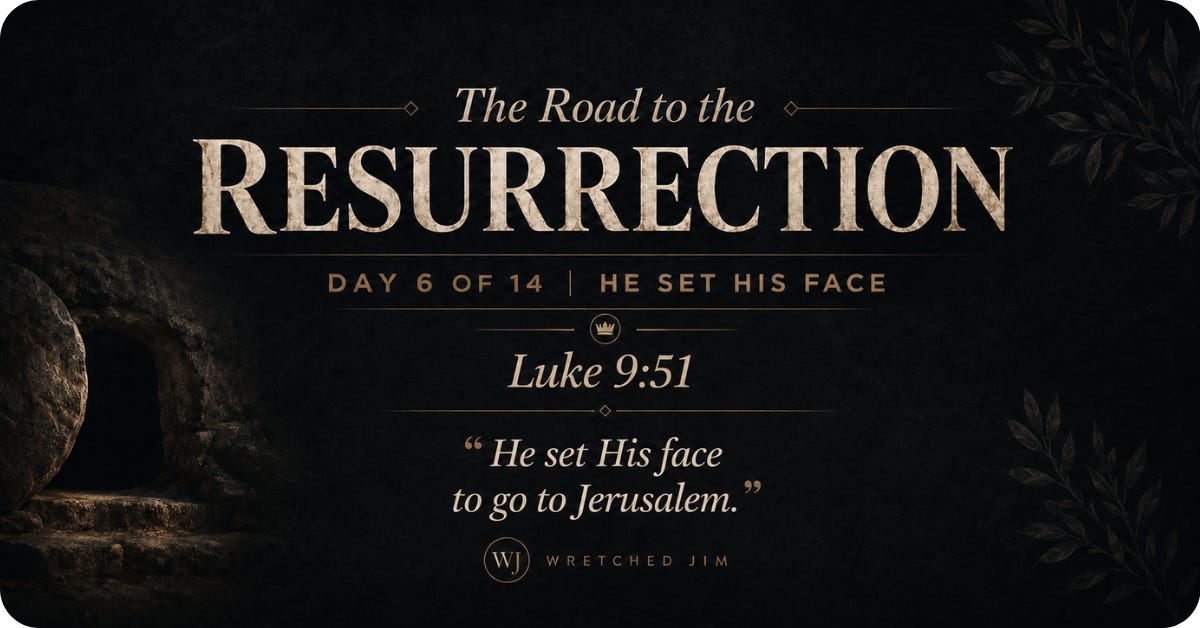
Yesterday, we heard the voice of the suffering servant in Psalm 22. David gave words that extended farther than his own life, words that would one day come from the mouth of Jesus as He hung on the cross. Isaiah had already shown us what the servant’s death would accomplish. David, then, let us hear what that suffering would sound like. Together, they gave a picture so clear that only one thing was still missing. The servant hadn’t yet come into the fullness of time.
That’s what we come to today.
For five days now, we’ve been tracing a thread that God wove through the Old Testament over centuries. It started in the garden, where He promised the seed of the woman would crush the serpent. It continued on Moriah, where a ram died in the place of a son. Then at Passover, we saw the blood of lambs stand between households and judgment. Then it came into even sharper view through Isaiah and David, where God revealed the meaning of the servant’s suffering and the voice of the One who would endure it. All of that pointed forward. All of it was waiting for the moment when the One these Scriptures described would walk toward the place where they would be fulfilled.
Luke records that moment in a sentence so brief it would be easy to read past it if we weren’t paying attention.
“When the days were approaching for His ascension, He set His face to go to Jerusalem.” (Luke 9:51)
This verse is a turning point in Luke’s Gospel. Everything before it centered around Jesus’ ministry. He taught, healed, cast out demons, revealed His authority, and showed the crowds who He is. Everything after this moves toward Jerusalem, the place where He’ll be rejected and crucified. Luke indicates that transition with one sentence,.
“He set His face to go to Jerusalem.” That’s the language of intentionality. resolve. Jesus turns toward Jerusalem with a purpose. The wording repeats Isaiah 50:7, where the servant of the Lord says, “I have set my face like flint, and I know that I will not be ashamed.” Luke’s not just telling us that Jesus started moving toward a specific place. He’s showing that the suffering servant Isaiah described is now moving deliberately toward the hour appointed for Him.
Jesus knew what waited for Him there. Jerusalem was not an unknown destination. He knew the hatred of the religious leaders. He knew the betrayal that was coming. He knew the mockery, the scourging, the nails, and the wrath He would bear. He knew that the road before Him ended at a cross. And with that knowledge fully before Him, He set His face toward the city and began to walk. This was the purpose of His coming, and He started moving toward it.
This is where everything we’ve covered in the previous five days starts to come together. The servant Isaiah saw, the One crushed for the iniquity of His people, is now on the road. The sufferer David heard crying out in Psalm 22 is now moving toward the place where those words come to pass. The Lamb foreshadowed on Moriah and at Passover is no longer a shadow and type. He’s a man walking toward Jerusalem, and He’s doing so willingly.
Everything that comes from this point on in Luke’s Gospel happens as a result of this moment. Every word spoken on the road, every encounter along the path, every warning, every act of mercy, every step toward the city, all happen because Jesus has already determined where He’s going. He’s moving toward the cross, and He’s going there on purpose.
What God promised in the garden, pictured on the mountain, marked in blood at Passover, and revealed through the prophets, is now being brought to fulfillment by the One who came to accomplish it. The servant’s no longer only promised. He’s on the path, He set His face toward Jerusalem.
Tomorrow, the story continues as we go to the triumphal entry and the beginning of the final week.
In His Service,

I talk about Jesus and the Bible a lot. Sometimes on the radio, sometimes to people who willingly show up to listen. Occasionally, I write things down.
Before You Go
Word of mouth predates every distribution platform ever built and still outperforms them. When someone sends you an article, you’re more likely to take it seriously because you trust the person who sent it. So, you’re not starting from scratch, you already have a reason to give it your attention.
Most of the people who read this got here that way. Passing something along like that is still the most helpful thing you can do.
Support the Writing (if you want)
Wretched Jim is free to read. If the writing has been helpful and you’d like to support the work, you can give here. No paid subscription necessary.