


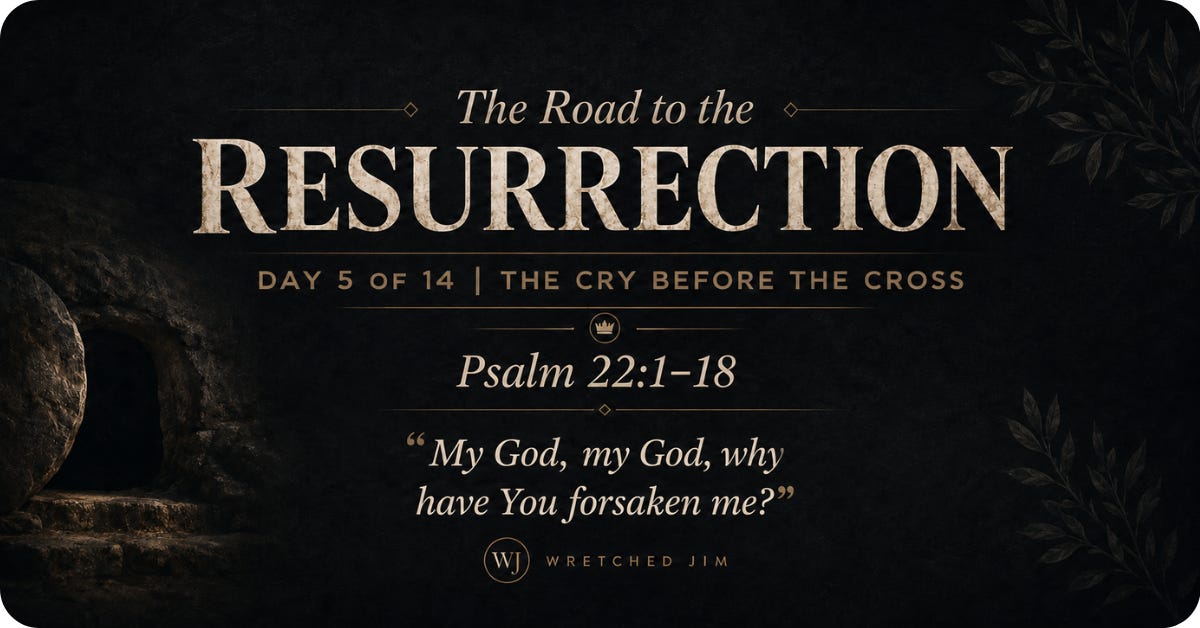
Yesterday, we stood in Isaiah 53, where the identity of the suffering servant came into view. Isaiah showed us what His death would mean. He would be pierced and crushed for the iniquity of His people. The Lord would lay their guilt on Him, and His life would be given as the guilt offering. Isaiah gave us the theology of the cross, but what he didn’t give us was the sound of the suffering from the lips of the One enduring it.
That’s what Psalm 22 gives.
David wrote Psalm 22 about three centuries before Isaiah and about a thousand years before the crucifixion of Jesus, but the psalm reads with incredible detail. It opens with words that have become permanently attached to the cross because Jesus Himself spoke them.
“My God, my God, why have You forsaken me? Far from my deliverance are the words of my groaning. O my God, I cry by day, but You do not answer; and by night, but I have no rest.” (Psalm 22:1-2)
David wrote those words out of pain. He knew what it meant to suffer, but Psalm 22 does more than describe David's pain. The further it goes, the clearer it becomes that the Spirit of God was giving David language much bigger than himself.
“I am poured out like water, and all my bones are out of joint; my heart is like wax; it is melted within me. My strength is dried up like a potsherd, and my tongue cleaves to my jaws; and You lay me in the dust of death. For dogs have surrounded me; a band of evildoers has encompassed me; they pierced my hands and my feet. I can count all my bones. They look, they stare at me; they divide my garments among them, and for my clothing they cast lots.”
(Psalm 22:14-18)
Those details don’t fit anything we know about David’s life. No one pierced his hands and feet. No one stood over him and divided his garments by lot. The physical suffering described here goes further than the language of general pain and to the kind of suffering that would only make sense when the Son of God was lifted up on a cross. David wrote it, but David didn’t live it.
And when the day came, the correlation was plain. The piercing of the hands and feet fits the crucifixion. The dividing of garments and the casting of lots happened at the foot of the cross. Even the physical descriptions, bones out of joint, and the tongue clinging to the jaws, match the brutality of the crucifixion with accuracy. Psalm 22 doesn’t just sound close to the events of Calvary, it speaks about them with a clarity that only divine inspiration can explain.
What Psalm 22 adds to the thread we’ve been tracing is something crucial. Isaiah gave us the meaning of the servant’s suffering. Psalm 22 gives us the voice of the sufferer Himself. The statement, “My God, my God, why have You forsaken me,” isn’t a statement of confusion. It’s the lament of the sin-bearer. The One Isaiah saw bearing the iniquity of His people. The judgment that belonged to others is falling on Him.
And David wrote those words a thousand years before there was a cross.
The thread continues to get clearer. What started as a promise in the garden, and then appeared in a substitute on Moriah, and then in the blood of lambs at Passover, has now been given a prophecy in both picture and sound from Isaiah and David. The One who would bear the sin of His people wasn’t only revealed in what He would accomplish. He was revealed in what He would live through.
Tomorrow, the story continues as we go to Luke 9:51.
In His Service,

I talk about Jesus and the Bible a lot. Sometimes on the radio, sometimes to people who willingly show up to listen. Occasionally, I write things down.
Before You Go
Word of mouth predates every distribution platform ever built and still outperforms them. When someone sends you an article, you’re more likely to take it seriously because you trust the person who sent it. So, you’re not starting from scratch, you already have a reason to give it your attention.
Most of the people who read this got here that way. Passing something along like that is still the most helpful thing you can do.
Support the Writing (if you want)
Wretched Jim is free to read. If the writing has been helpful and you’d like to support the work, you can give here. No paid subscription necessary.