


Yesterday, we looked at the Passover in Exodus 12. The method of substitution first seen with Abraham and Isaac had now grown to an entire nation. Thousands of lambs died so that thousands of firstborn sons would receive mercy, and the blood on the doorposts was the difference between judgment and mercy for every home. It was a clear picture, but it was still only a picture. The lambs killed at Passover couldn’t take away sin. They pointed to something greater, and for more than a thousand years, the identity of the One they foreshadowed wasn’t revealed.
Between Exodus and Isaiah, the story of Israel covered a lot of ground. God brought His people out of Egypt, gave them His law, led them through the wilderness, and brought them to the land promised to Abraham. Israel became a kingdom under David and Solomon, but that kingdom didn’t hold. It divided, and the people fell repeatedly into idolatry, bringing judgment on themselves. By the time Isaiah was writing, Assyria had already taken the northern kingdom, and Judah was on that same path. The sacrificial system was still there, and Passover was still being observed. But the nation’s sin kept piling up, and the consequences of that sin were never going to be taken away by the blood of an animal.
It was in that context that God gave Isaiah a prophecy so specific and so clear that, when we read it, it seems less like prophecy and more like someone describing events he had already seen, even though they wouldn’t happen for another seven hundred years.
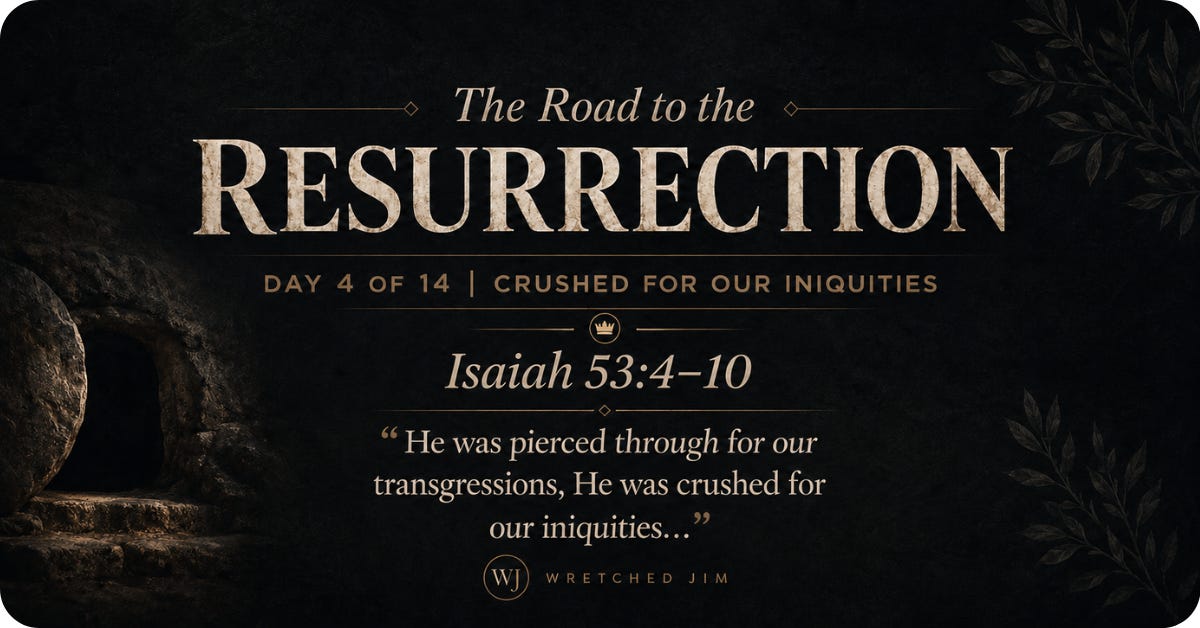
“Surely our griefs He Himself bore, and our sorrows He carried; yet we ourselves esteemed Him stricken, smitten of God, and afflicted. But He was pierced through for our transgressions, He was crushed for our iniquities; the chastening for our well-being fell upon Him, and by His scourging we are healed. All of us like sheep have gone astray, each of us has turned to his own way; but the Lord has caused the iniquity of us all to fall on Him.” (Isaiah 53:4-6)
What Isaiah describes here is substitution, the same truth we saw on Moriah and at the Passover, but now it’s moved beyond rams and lambs. Isaiah is describing a person. He carries grief and sorrow. He’s pierced and crushed, and the suffering He endures purchases something for the people He suffers for. That language is intentional. This is the picture of a man bearing the burden others deserve.
And the most important statement in the whole passage, “the Lord has caused the iniquity of us all to fall on Him.” God Himself is the one doing it. The wickedness is ours, but God lays it on the servant by His own sovereign will. That’s the foundation of what the cross accomplishes, and Isaiah saw it seven hundred years before it happened.
The passage keeps going, and what it says next is even more amazing.
“But the Lord was pleased to crush Him, putting Him to grief; if He would render Himself as a guilt offering, He will see His offspring, He will prolong His days, and the good pleasure of the Lord will prosper in His hand.” (Isaiah 53:10)
“The Lord was pleased to crush Him.” That sentence offends us today, and it should, because it forces us to face something most people would rather avoid. The suffering of this servant wasn’t an accident, it was suffering God ordained. And in that sense, it pleased God to do. “Pleased” here is the idea of God’s will being carried out. So, the crushing of the servant fulfilled what God planned, and the outcome of that crushing would be a life given for others.
Then Isaiah calls the servant “a guilt offering.” That language comes directly from the sacrificial system in Leviticus. The guilt offering was the sacrifice that directly dealt with the debt of sin. So when Isaiah says “guilt offering,” he’s saying that the servant’s death will accomplish what all the sacrifices before it couldn’t. This servant will pay the debt owed by the sins of others in full.
Every thread we’ve followed so far comes together in Isaiah 53. What began in the garden and continued through Moriah and Passover all led to this servant.
He would be pierced and crushed for the iniquity of His people, and through His suffering, they would be healed.
Tomorrow, the story continues as we go to Psalm 22.
In His Service,

I talk about Jesus and the Bible a lot. Sometimes on the radio, sometimes to people who willingly show up to listen. Occasionally, I write things down.
Before You Go
Word of mouth predates every distribution platform ever built and still outperforms them. When someone sends you an article, you’re more likely to take it seriously because you trust the person who sent it. So, you’re not starting from scratch, you already have a reason to give it your attention.
Most of the people who read this got here that way. Passing something along like that is still the most helpful thing you can do.
Support the Writing (if you want)
Wretched Jim is free to read. If the writing has been helpful and you’d like to support the work, you can give here. No paid subscription necessary.