


Yesterday, we started the Road to the Resurrection in Genesis 3, where God made the first promise of salvation even as the curse was being given. From the woman would come a promised seed who would crush the serpent’s head, though He would suffer for it. That was the foundation. The cross began with a promise in the garden.
Today, we fast-forward nearly twenty chapters, and that passage of time is important. Between Genesis 3 and Genesis 22, the story of humanity has already spiraled. Cain killed Abel, the world grew so corrupt that God sent a flood and started over with Noah, and the nations scattered at Babel. And then, in Genesis 12, God did something that dramatically narrowed the scope of the promise. He called one man, Abram, out of Ur of the Chaldeans and told him that through his offspring all the nations of the earth would be blessed. The promise God made in Genesis 3 about a coming seed was still alive, but now the promise was tied to a specific line. The deliverer would come through Abraham’s lineage.
That’s what makes Genesis 22 so profound. In this chapter, we see God asking Abraham to sacrifice his son, through whom the promise was meant to be fulfilled.
“He said, ‘Take now your son, your only son, whom you love, Isaac, and go to the land of Moriah; and offer him there as a burnt offering on one of the mountains of which I will tell you.’” (Genesis 22:2)
Isaac was the child of promise that Abraham and Sarah waited decades for. God made it clear that the covenant would continue through Isaac, and now God was telling Abraham to put him on an altar and light the fire. Everything God had promised seemed to collapse into a single, impossible command.
And Abraham obeyed. Early the next morning, he set out for Moriah with Isaac and the wood for the sacrifice. The text gives no indication of hesitation of any kind.
On the way up the mountain, Isaac asked the question,
“Behold, the fire and the wood, but where is the lamb for the burnt offering?” (Genesis 22:7)
Isaac could see what was missing. There was everything needed for a sacrifice except the sacrifice itself.
Abraham’s answer is one of the most important sentences in the Old Testament.
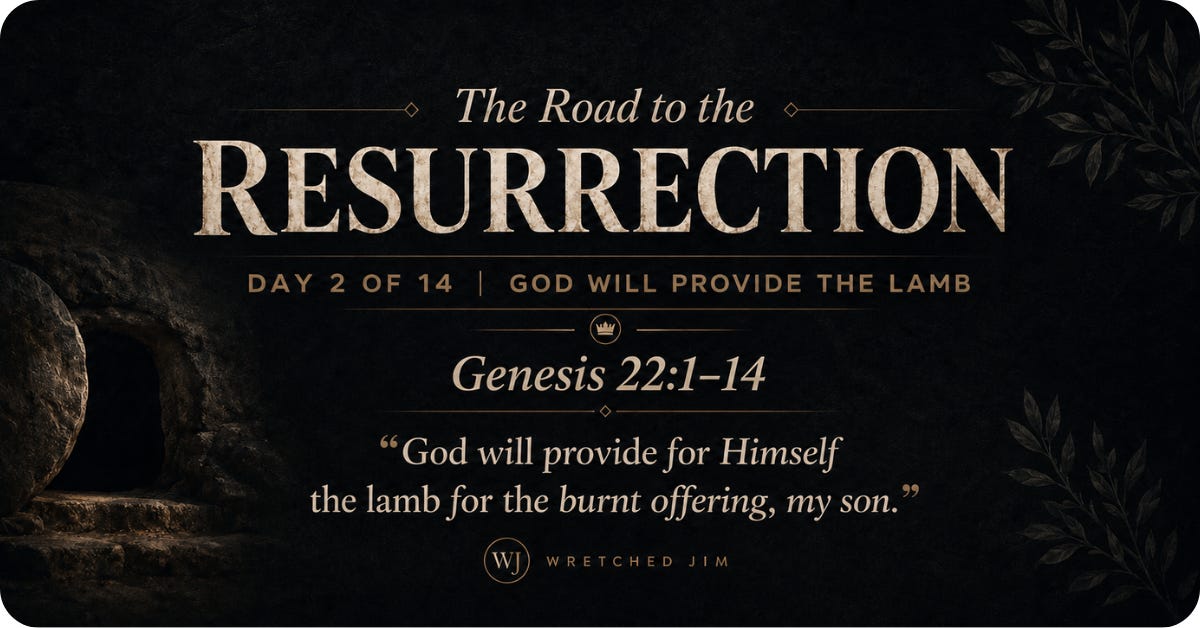
“God will provide for Himself the lamb for the burnt offering, my son.” (Genesis 22:8)
Abraham said more than he understood. In that moment, he was trusting that God would take care of what seemed impossible. And God did. When Abraham raised the knife, the angel of the Lord stopped him, then Abraham looked up and saw a ram caught in the thicket. God had provided a substitute. The ram died in Isaac’s place, and Abraham named the location, “The Lord Will Provide.”
But the answer Abraham gave Isaac on the road carries meaning that reaches far beyond that moment. God will provide for Himself the lamb. He said it about a ram caught in the thicket, but those words landed on a cross outside Jerusalem two thousand years later. God did provide the Lamb, His own Son. And the mountain where Abraham raised the knife over Isaac is in the same area where that Lamb would eventually be offered.
The pattern is plain. An only son, loved by his father, carrying the wood for his own sacrifice up a hill in Moriah. And at the pivotal moment, a substitute provided by God so the son could live. Every piece of this story points forward to something bigger, and what makes it so astonishing is that the people living through it could see only part of what God was doing.
Yesterday, the promise was made. Today, the promise closed in on a specific lineage, and the pattern of substitution was revealed for the first time. A life given in place of another, provided by God Himself.
Tomorrow, the story continues as we go to Exodus 12.
In His Service,

I talk about Jesus and the Bible a lot. Sometimes on the radio, sometimes to people who willingly show up to listen. Occasionally, I write things down.
Before You Go
Word of mouth predates every distribution platform ever built and still outperforms them. When someone sends you an article, you’re more likely to take it seriously because you trust the person who sent it. So, you’re not starting from scratch, you already have a reason to give it your attention.
Most of the people who read this got here that way. Passing something along like that is still the most helpful thing you can do.
Support the Writing (if you want)
Wretched Jim is free to read. If the writing has been helpful and you’d like to support the work, you can give here. No paid subscription necessary.