


Yesterday, Jesus died. The Son of God set His face toward Jerusalem, knowing what was waiting for Him there, and He yielded up His spirit on the cross while the sky went dark. The veil in the temple tore from top to bottom. A centurion looked at His body and said, “Truly this was the Son of God.” And then it was over, the crowds went home. Evening was approaching, and the body of Jesus still hung on the cross.
“When it was evening, there came a rich man from Arimathea, named Joseph, who himself had also become a disciple of Jesus. This man went to Pilate and asked for the body of Jesus. Then Pilate ordered it to be given to him. And Joseph took the body and wrapped it in a clean linen cloth, and laid it in his own new tomb, which he had hewn out in the rock; and he rolled a large stone against the entrance of the tomb and went away.”
(Matthew 27:57-60)
Joseph of Arimathea sat on the Sanhedrin, the same body that condemned Jesus the night before. Matthew makes a point of telling us Joseph hadn’t consented to that decision. He was a disciple, though John’s account says he’d kept it quiet out of fear. Whatever fear kept him silent during the trial vanished at the cross. Joseph went to Pilate and asked for the body of a man who’d just been executed as a criminal. That request was risky. He was identifying himself publicly with a condemned man, putting everything he’d built on the line to do it.
He wrapped the body in clean linen and laid it in his own new tomb, one carved from rock that never held a body before. Matthew includes that detail because it matters for what’s coming. When the tomb is found empty on Sunday morning, there will be no question about whose body was supposed to be inside.
The religious leaders, meanwhile, were still at work.
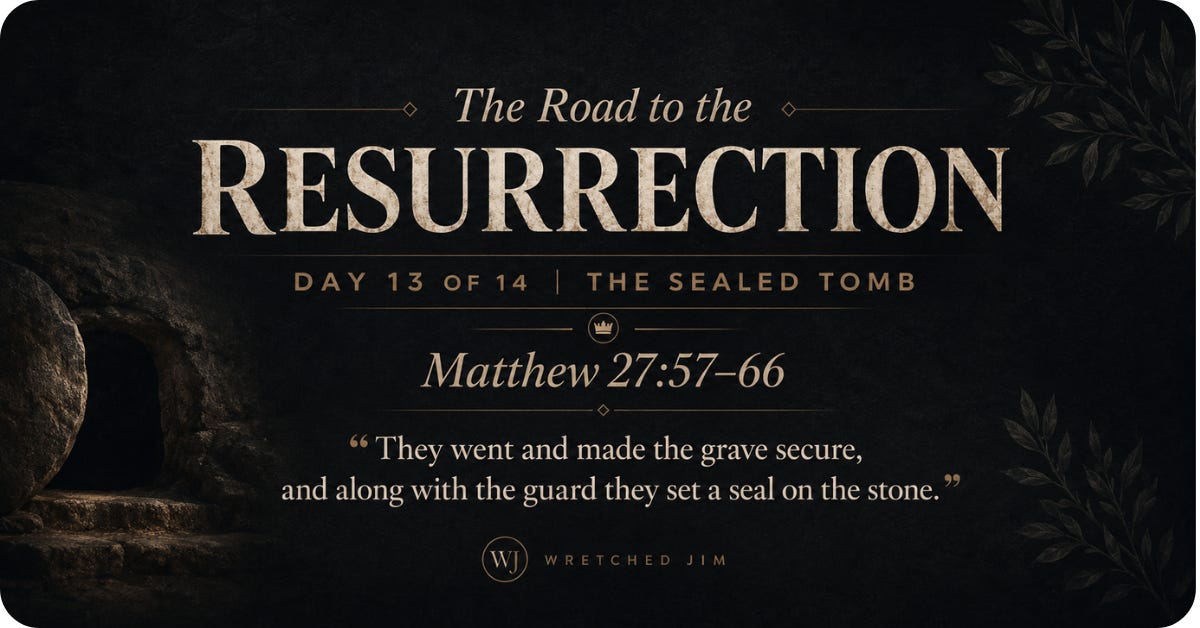
“Now on the next day, the day after the preparation, the chief priests and the Pharisees gathered together with Pilate, and said, ‘Sir, we remember that when He was still alive that deceiver said, After three days I am to rise again. Therefore, give orders for the grave to be made secure until the third day, otherwise His disciples may come and steal Him away and say to the people, He has risen from the dead, and the last deception will be worse than the first.’ Pilate said to them, ‘You have a guard; go, make it as secure as you know how.’ And they went and made the grave secure, and along with the guard they set a seal on the stone.”
(Matthew 27:62-66)
The irony here is incredible. The chief priests remembered what Jesus said about rising on the third day. The disciples apparently didn’t, or if they did, the trauma of Friday had buried it. The enemies of Jesus took His promise of resurrection more seriously than His own followers. So they stationed a guard and sealed the tomb, doing everything in their power to make sure what Jesus predicted couldn’t come true.
They made the grave as secure as they knew how. That phrase deserves consideration. It says they brought the full weight of Roman authority to stand guard in front of a sealed and borrowed tomb and believed it would be adequate. It’s the final act of a religious establishment that spent the entire week trying to control something that was never theirs to control.
And then Saturday came. The text gives us nothing about Saturday. The body of Jesus lay in a sealed tomb under Roman guard, and the world was silent. The disciples were grieving behind locked doors, and every promise Jesus made about rising again must have felt like words spoken by a man who was now dead. Whatever faith they’d carried into the upper room on Thursday night had crashed head-on with Friday afternoon. And Saturday was the long, unbearable time between the worst thing they’d ever witnessed and a Sunday morning they didn’t yet know was coming.
Tomorrow is Resurrection Sunday.
In His Service,

I talk about Jesus and the Bible a lot. Sometimes on the radio, sometimes to people who willingly show up to listen. Occasionally, I write things down.
Before You Go
Word of mouth predates every distribution platform ever built and still outperforms them. When someone sends you an article, you’re more likely to take it seriously because you trust the person who sent it. So, you’re not starting from scratch, you already have a reason to give it your attention.
Most of the people who read this got here that way. Passing something along like that is still the most helpful thing you can do.
Support the Writing (if you want)
Wretched Jim is free to read. If the writing has been helpful and you’d like to support the work, you can give here. No paid subscription necessary.