


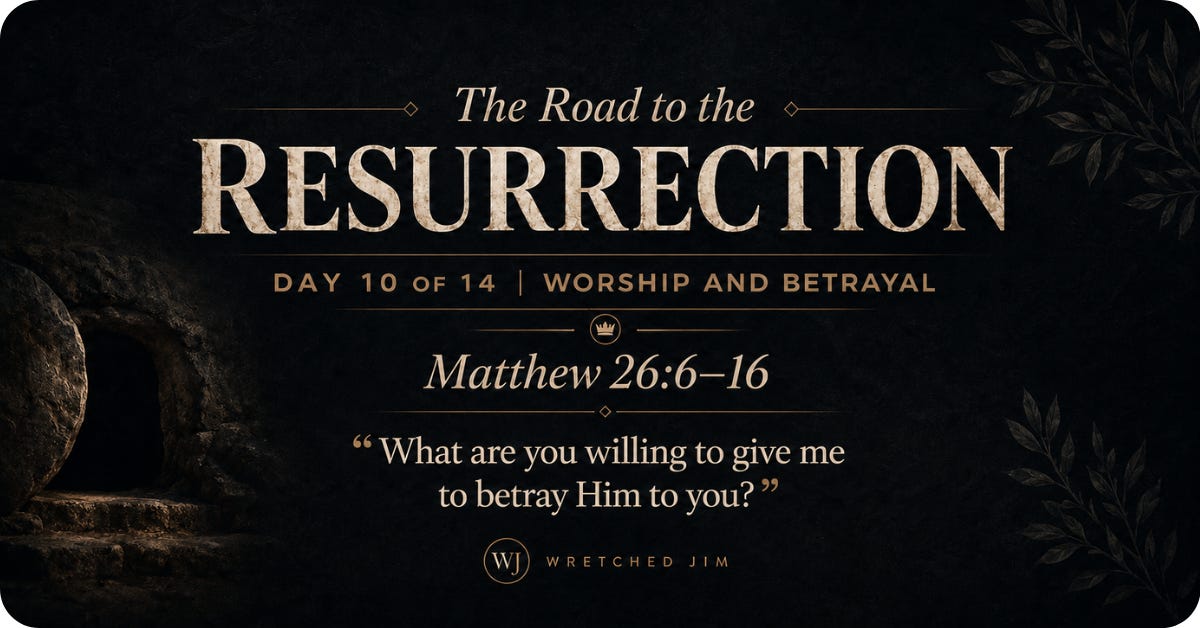
Yesterday, we watched the Pharisees go silent when Jesus asked them a question they couldn’t answer without acknowledging who He was. Rather than follow the logic of their own theology, they shut down. Matthew says no one dared to ask Him anything from that day forward. But their silence was strategic. A decision was already taking shape in the background as Jesus sat at a table in Bethany.
Matthew puts two scenes side by side in our text today, and that’s deliberate. The first scene is an act of worship, while the second is an act of betrayal.
“Now when Jesus was in Bethany, at the home of Simon the leper, a woman came to Him with an alabaster vial of very costly perfume, and she poured it on His head as He reclined at the table.” (Matthew 26:6-8)
The perfume was expensive, and Mark’s Gospel tells us it was worth roughly three hundred denarii, which was close to a year’s income. The woman broke the vial and poured the entire thing over Jesus' head. She gave everything she had.
The disciples reacted with contempt.
“Why this waste? For this perfume might have been sold for a high price and the money given to the poor.” (Matthew 26:8-9)
That sounds reasonable on the surface, and in most cases it would be. But Jesus corrected them and said something that changed the entire situation.
“Why do you bother the woman? For she has done a good deed to Me. For you always have the poor with you; but you do not always have Me. For when she poured this perfume on My body, she did it to prepare Me for burial.” (Matthew 26:10-12)
Jesus clarified the woman’s act as “preparation for His burial.” Whether she understood the significance of that or not, we’re not told. But Jesus knew the cross was close, and He accepted her offering as an anointing for what was coming. In a room of people who followed Him for years, this woman accomplished the one thing that recognized the reality none of them would. Jesus was about to die, and her offering was the appropriate response to a truth that everyone else was still avoiding.
And then Matthew cuts to Judas.
“Then one of the twelve, named Judas Iscariot, went to the chief priests and said, ‘What are you willing to give me to betray Him to you?’ And they weighed out thirty pieces of silver to him. From then on he began looking for a good opportunity to betray Jesus.” (Matthew 26:14-16)
The comparison, or better yet, the contrast here is severe. In one scene, a woman pours everything she has over the head of the Son of God. In the next, one of His own disciples walks into a room of priests and asks what they’ll pay him to hand Jesus over. She gave without counting any cost. He counted the cost and decided Jesus was worth thirty pieces of silver, the Old Testament price of a slave.
Matthew doesn’t moralize about the difference; he just puts the two scenes side by side. The same Jesus who received extraordinary worship from an unnamed woman is now being sold by a man who shared His table. The final week is speeding up, and those who bring Jesus to the cross are moving into position.
Tomorrow we go to the upper room.
In His Service,

I talk about Jesus and the Bible a lot. Sometimes on the radio, sometimes to people who willingly show up to listen. Occasionally, I write things down.
Before You Go
Word of mouth predates every distribution platform ever built and still outperforms them. When someone sends you an article, you’re more likely to take it seriously because you trust the person who sent it. So, you’re not starting from scratch, you already have a reason to give it your attention.
Most of the people who read this got here that way. Passing something along like that is still the most helpful thing you can do.
Support the Writing (if you want)
Wretched Jim is free to read. If the writing has been helpful and you’d like to support the work, you can give here. No paid subscription necessary.